-
02 November 2022
Category : Opinion
Living without discrimination in Morocco
Over the last twenty years, Morocco has gone from being a country of emigration to a country of transit and settlement of migrants. This new dimension of migratory movements confronts Moroccan society with new realities that need to be gradually integrated at the political, economic and social levels
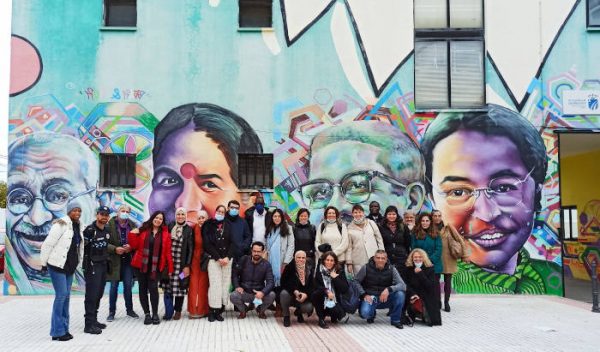
Sara Gutiérrez Leiva, coordinator of the project “Living Together Without Discrimination: A Human Rights and Gender-Based Approach
A challenge for the country: the National Strategy for Immigration and Asylum
Morocco receives a steadily increasing number of migrants each year, mainly from Sub-Saharan Africa. This growth has demanded stronger institutional resources to guarantee the rights of newcomers and to improve the integration of Moroccans and people of other nationalities living in its territory.
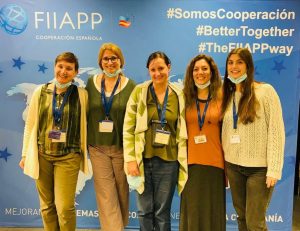
FIIAPP team of the ‘Living without discrimination in Morocco’ project’ Despite legal progress, migrants and refugees remain vulnerable to incidents of racial discrimination. Several civil society organizations have documented cases showing barriers to accessing housing, healthcare, employment, and education for migrant children.
Although authorities combat racism in Morocco, it still affects social inclusion and poses a challenge to the country’s social cohesion.
These racist incidents not only harm victims but also threaten coexistence and the overall well-being of society. As the International Organization for Migration (IOM) has pointed out, discrimination erodes trust in institutions and hinders civic participation.For this reason, in 2014 the Kingdom of Morocco adopted the National Strategy for Immigration and Asylum (ENIA), a pioneering framework that brought migration issues into public policy. Thanks to this strategy, the country has made progress in areas such as education, health, housing, vocational training, and employment.
The “Living Together Without Discrimination” project aligns with ENIA’s goals, particularly those related to fighting discrimination and raising awareness about migration and asylum.The “Living Together Without Discrimination” project
A plural and diverse society has much to gain: social cohesion and collective determination to ensure that racism and xenophobia have no place within its borders. In this sense, projects like “Living Together Without Discrimination” lay the foundation to improve people’s lives through a human rights-based approach, with special attention to the experiences of women in Morocco—particularly migrant women, who may face discrimination based on both gender and origin.
This initiative, promoted by the European Union, the Spanish Agency for International Development Cooperation (AECID), FIAP, and the Spanish Observatory on Racism and Xenophobia (OBERAXE), incorporates a gender perspective essential to understanding multiple levels of vulnerability. According to UN Women, migrant women face greater risks of exclusion and violence, reinforcing the need for gender-sensitive public policies.
The project’s objective has been to strengthen tools and public policies aimed at preventing racism and xenophobia in Morocco, fostering peaceful coexistence free of discrimination.
How it was implemented
Institutional strengthening: Support for developing the technical capacities of public administrations in key sectors such as education, healthcare, justice, and local governance, as well as civil society organizations that play a crucial role in preventing racism and xenophobia.
International cooperation: Integration of collaborative approaches among Moroccan, North African, and European partners, creating a space for dialogue, reflection, and exchange of experiences.
Awareness and media: Launch of communication campaigns and awareness activities alongside journalists and local media to improve migration coverage and combat stereotypes surrounding the migration phenomenon.
Regulatory reforms: Technical assistance to improve Moroccan legislation, reinforce complaint mechanisms, and ensure more rigorous data collection on racial discrimination cases.
International best practices: Promotion of successful experiences from countries such as Tunisia or Spain, serving as references for strengthening migrant inclusion in Morocco.
Dialogue spaces: Creation of consultation forums between civil society and Moroccan public institutions, opening for the first time institutional debates on racism and xenophobia in the country.
It is said that knowledge is the best capital, which is why we are launching a series of publications that bring together all the work done, achievements, recommendations and lessons learned. A total of 14 publications covering the five components of the project shed light on essential issues to address racism and xenophobia in Morocco.
Knowledge and learning
Knowledge is often said to be the best capital. For that reason, the project has produced a series of publications that compile its work, achievements, recommendations, and lessons learned. In total, 14 documents have been developed, addressing the project’s five components and shedding light on key issues for tackling racism and xenophobia in Morocco and strengthening social cohesion.
-
Report on the analysis of international norms and recommendations on combating discrimination, racism, and xenophobia. Identifies international and regional norms (UN, European Union, South America, and Africa) that protect migrants.
-
Comparative study of legislation on racial discrimination, racism, and xenophobia in Spain, France, Tunisia, and Morocco, with proposals to strengthen national protection mechanisms.
-
Analysis of training programs for public administration personnel, based on European experiences in preventing racism, with specific recommendations for Morocco.
-
Study on best practices in communication and awareness in Belgium, Spain, Finland, France, and the Netherlands, to inspire campaigns within the Moroccan context.
-
Training manuals for public administrations and local governments, integrating a gender approach in the fight against discrimination.
-
Report on the intersectionality of discrimination based on race, ethnicity, and gender, analyzing its institutional treatment in Morocco and proposing tools to incorporate this perspective into public policies.
These materials are available in Arabic, French, Spanish, and English, in both full and summarized versions, and can be accessed through the FIAP portal.
ResumenNombre del artículoLiving without discrimination in MoroccoDescripciónOver the last twenty years, Morocco has gone from being a country of emigration to a country of transit and settlement of migrants. This new dimension of migratory movements confronts Moroccan society with new realities that need to be gradually integrated at the political, economic and social levelsAutorFIAP Fundación para la Internacionalización de las Administraciones PúblicasPublisher Namehttps://www.fiap.gob.esPublisher Logo
The views and opinions expressed in this blog are the sole responsibility of the person who write them.
-