

31/10/2025
Police forces and drug enforcement agencies from Latin America, the Caribbean and Europe exchange experiences at a workshop aimed at improving the management and disposal of chemicals that can be used to manufacture narcotics.
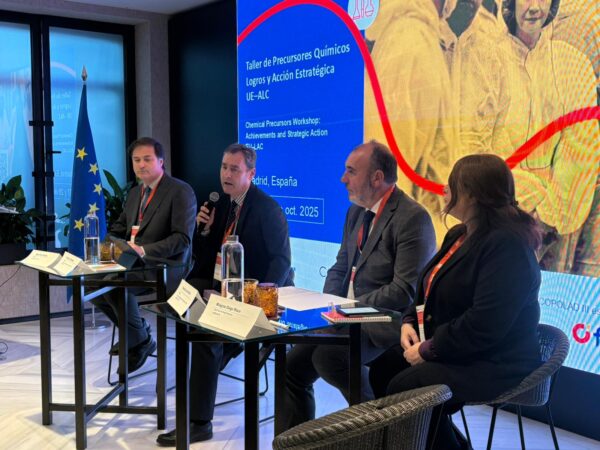
The COPOLAD III Programme led by FIAP held the Chemical Precursors Workshop: Achievements and Strategic Action EU–LAC in Madrid this week, a meeting that brought together government representatives, international organisations and technical experts to consolidate experiences, promote good practices and define the next steps in bi-regional cooperation on the control and sustainable management of chemical precursors.
Over two days of work, participants analysed the progress made in COPOLAD III’s line of action dedicated to controlling precursors for the illicit manufacture of drugs, identifying common challenges and joint strategies to strengthen regulatory frameworks, institutional coordination and cross-border cooperation.
COPOLAD III works alongside Latin American and Caribbean countries, under the technical leadership of Spain’s Intelligence Centre against Terrorism and Organised Crime (CITCO), to strengthen precursor control systems, improve regulatory frameworks and promote regional cooperation. In this context, the programme promotes information exchange, technical training and environmentally safe management, contributing to a more effective and sustainable response to the drug problem.
In the area of precursor management and disposal, reference manuals were developed and officially approved in seven countries—Bolivia, Colombia, Ecuador, El Salvador, Honduras, Paraguay, and the Dominican Republic—establishing guidelines for the handling, transport, and disposal of these substances. In addition, 668 civil servants received specific training in the application of these manuals. Complementarily, more than 100 officials from Latin America and the Caribbean participated in the two editions of the 500-hour Advanced Specialisation Course on the Control and Investigation of Drug Precursors, developed in collaboration with the UNED Foundation of Spain.
“The key tool for tackling the problem of new synthetic drugs and chemical precursors is international cooperation” – Francisco Tierraseca (Director of FIAP)
In terms of regulations, COPOLAD III has supported Colombia, El Salvador, Honduras, the Dominican Republic, Antigua and Barbuda, and Saint Lucia in updating or creating legal frameworks aimed at harmonising national regulations, improving inter-institutional coordination, and promoting a comprehensive approach to the control and management of precursor chemicals.
Similarly, in Ecuador, the programme contributed to the development of a technological tool to strengthen the analysis, monitoring and control of transactions involving controlled substances, incorporating the guidelines contained in the reference manuals.
‘International cooperation is an irreplaceable pillar in the fight against precursor trafficking, which knows no borders. We reiterate our commitment to continue collaborating with the COPOLAD Programme’ – Francisco Javier Marín (Director of CITCO)
The workshop was opened by Francisco Tierraseca, Director of FIAP, and Francisco Javier Marín Lizarraga, Director of CITCO. In the opening session, Borja Díaz Rivillas, Director of COPOLAD III, and Milagros Diego Risco, Head of the Precursors Task Force, presented an overview of the actions taken and results achieved in this area of work.
“We are working towards greater control of chemical precursors at a time when organised crime has more methods at its disposal and more psychoactive substances are emerging, as well as a commitment to the environment and health” – Borja Díaz (director of COPOLAD III)
Throughout the meeting, key issues were addressed, such as current difficulties in controlling precursors, new trends and designer precursors, harmonisation of regulations in Latin America and the Caribbean, and cooperation with the private sector. Treatment manuals for the management and final disposal of precursors and chemicals were also presented, developed as support tools for countries in the region.
“We need a flexible system that can adapt to the emergence of new psychoactive substances. Management and disposal systems must be improved to minimise risks to safety, health and the environment” – Milagros Diego (COPOLAD III expert)
The closing ceremony was led by Borja Díaz Rivillas, Milagros Diego Risco and Trotsky Gustavo Santamaría, who highlighted the commitment of the participating countries and the importance of continuing to promote a comprehensive approach that links public health, environmental protection and international cooperation.