



10/04/2026
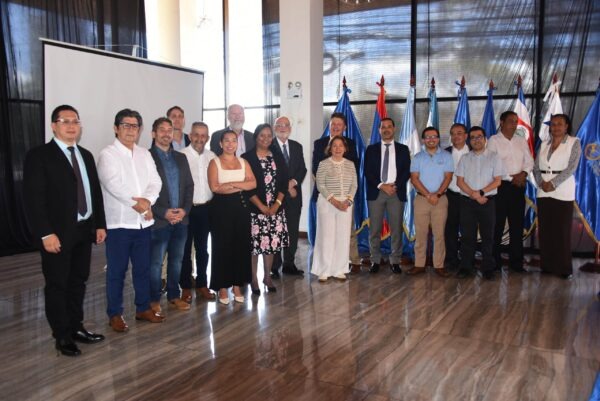
The heads of the meteorological services of Belize, Costa Rica, El Salvador, Guatemala, Honduras, Nicaragua, Panama and the Dominican Republic, along with international experts, are meeting in Costa Rica at an event organised by FIAP to promote collaboration on climate issues.
01/04/2026
23/01/2024
22/10/2024
On 8 and 9 April, the Meeting of Directors of the National Meteorological Services of Central America and the Caribbean took place in San José (Costa Rica). During the meeting, organised by FIAP as part of the European EUROCLIMA Programme, with support from the Regional Committee on Water Resources and AEMET, progress was reported on the High-Resolution Climate Change Scenarios for Central America project. In addition, follow-up was given to the needs identified at previous meetings to work on homogeneous and standardised scenarios in the region that facilitate national and regional decision-making.
The high-resolution climate change scenario project has made progress in converting global climate information – such as that produced by the IPCC and the World Meteorological Organisation – into useful data at a local scale and with daily detail. As a result, the focus is no longer solely on general trends; it is now possible not only to estimate how specific variables (temperature, rainfall, extreme events) will change in a particular region, but also to translate these into directly applicable indicators, such as days of extreme heat, drought risk or water availability.
In addition, an interactive visualisation tool has been developed to make this information accessible to various sectors, and a permanent group of experts from the region’s meteorological services has been established to work in a coordinated manner – a key factor in ensuring consistency and continuity in the results.
This project bridges the gap between climate science and real-world decision-making. Sectors such as water, agriculture and energy can now rely on this data to better plan their adaptation to future climate conditions. A particularly significant recent advance is the improvement of the baseline historical climate data—by correcting data using actual observations—which increases the reliability of future scenarios.
During the meeting, heads of meteorological services across the region discussed how to improve the exchange of climate data in order to establish a robust, consistent and constantly improving foundation for developing the best possible climate change scenarios. These scenarios will enable the anticipation and mitigation of the effects of climate change, as well as the implementation of appropriate adaptation measures.
The meeting concluded with a commitment to share data within the working group, which will facilitate the creation of these climate scenarios. This will improve the results of the climate change scenarios generated for the entire region.