


19/12/2025
A workshop has been organised for judges, prosecutors and police officers, where Spanish and French specialists have worked hand in hand with their Peruvian counterparts, focusing on dismantling criminal organisations.
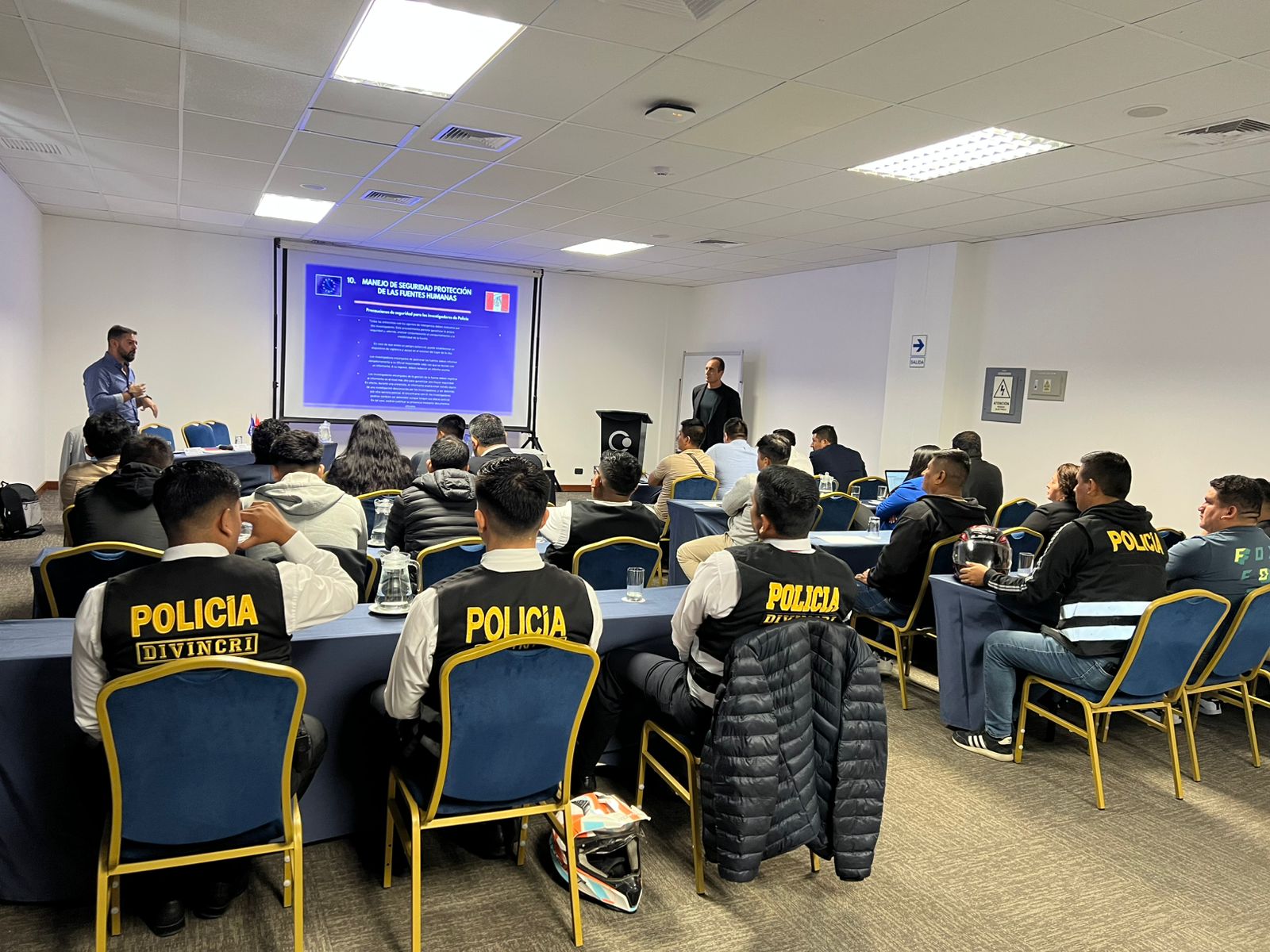
In a context where organised crime and illicit drug trafficking operate with increasing sophistication, human intelligence is a key factor in criminal investigations. With this in mind, the city of Trujillo, Peru, hosted a specialised workshop entitled ‘Recruitment and Management of Human Sources of Information’, organised by the European Union project to combat drugs and organised crime in Peru.
The workshop marked a milestone in the region by bringing together the three fundamental pillars of the criminal justice system in a single workspace: officers from the Peruvian National Police (PNP), prosecutors from the Public Prosecutor’s Office and judges from the Judiciary, with the aim of providing these operators with advanced tools for managing informants and collaborators, ensuring that the information obtained in the course of an investigation is transformed into valid and compelling evidence in court.
The training was delivered by two European experts from law enforcement agencies in Spain and France. This work has enabled participants to gain first-hand knowledge of how human sources are managed in Europe’s leading intelligence agencies, adapting this knowledge to the criminal and procedural reality in Peru.
The instructors shared protocols on how to approach potential informants within criminal structures, how to assess their reliability and, crucially, how to ensure their safety and that of the investigator in charge.
The workshop was designed with a highly practical approach. During the sessions, attendees actively participated in recruitment simulations, where police officers and prosecutors practised persuasion and negotiation techniques in simulated high-stress scenarios. They analysed real cases, learning about successful operations against drug trafficking where human sources were key to the success of the case. They also held a legal debate in which judges and prosecutors were able to learn in real time about the legal limits and judicial validation of information, resolving any doubts they had about the process.
The workshop has been a success in terms of inter-institutional strengthening and, in addition to knowledge transfer, has helped to promote a common language between police officers (responsible for the operational side) and the prosecution and judiciary (responsible for legality).
Organised crime cannot be tackled in isolation, and the joint work of police officers, prosecutors and judges in this type of training demonstrates the need to build strong networks against crime. Technology can help, but the ability to manage human resources remains irreplaceable for the development of complex investigations.
With the conclusion of this workshop, the European Union’s Bilateral Project in Peru reaffirms its commitment to continue supporting the Peruvian State in the fight against transnational crime, enhancing the technical capabilities of those on the front line of society’s defence.