-
Data protection means protecting people in such an important and essential aspect of their lives as their private, personal and family lives. Technology is going to change the world and the way we see and understand it. The real challenge is to use it responsibly, ethically and for the common good. To do this, we need robust legislation to ensure the protection of personal data.
What does data protection mean?
Data protection means protecting individuals in such an important and essential aspect of their lives as their private, personal and family lives, from the perspective of the use and processing of their personal data by any type of organisation, regardless of its size.
It responds to a fundamental, personal and non-transferable right enshrined in the Spanish constitution: privacy. This implies the obligation to preserve people’s identity, reputation and privacy; it means a guarantee of respect and security of personal data that third parties must observe when processing it. Privacy belongs to the category of personality rights, which means that protecting people’s dignity and guaranteeing respect for their private lives must be the basis for the protection of personal data.
Protecting data means that countries must have regulatory frameworks supplemented by a set of practical and sectoral provisions aimed at ensuring that a person’s personal data is not misused, without their authorisation or in a way that infringes on their rights and freedoms. The protection of personal data is a right granted to individuals so that they can know and control how third parties collect, use, store, share or delete their personal data and make their own decisions.
For an individual, having control over their data means deciding who can access their information, for what purpose, and for how long. This is part of respecting their fundamental rights.
Why is it important to protect data?
Personal data reveals key information about individuals: name, address, national identity number, financial situation, medical history, ideology, political opinion, trade union membership or sexuality.
If data is not protected, it could be used without the consent of the person to whom it belongs, which could cause significant harm affecting their personal life. Data can be used to steal someone’s identity and impersonate them by opening a bank account, taking out a loan, buying products online, changing email and social media passwords, contracting telephone services, or committing fraud or scams.
The unwanted processing of personal data also involves manipulating opinions or decisions, for example by displaying personalised fake news to influence voting in political campaigns; discrimination, such as offering more expensive insurance based on history; and profiling by insurance companies or targeted advertising that exploits emotions or insecurities.
In this context, it is important to note that the owners of personal data are the individuals themselves and never the organisations that process it.
In today’s digital world, personal data is as valuable as money
We currently live in a global, digitised and hyperconnected world, where every second an almost incalculable and ever-increasing volume of data travels through the network. At the end of the previous decade, personal data was referred to as the oil of the 21st century. Today, years later and well into the century, we no longer talk about oil but about petrol in the global economy. In today’s digital world, personal data is as valuable as money.
Almost everything a person does generates personal data: shopping, communicating, working, studying or entertaining themselves. But are you aware of who collects your data and how it will be processed? Technology has become integrated into people’s lives, into their normality, personal data is shared and actions are carried out using the network. This would never happen in analogue life and that is what we should reflect on.
What is done with the data requested from you?
Another interesting question is: what is the requested data used for? Is it really to provide the service that the person has requested?
The answer is no: in most cases, the data is used to create behavioural profiles, display personalised advertising, influence consumer or political decisions, sell the data to third parties without transparency and, ultimately, to feed artificial intelligence algorithms.
In many cases, problems associated with the lack of personal data protection have been reported, both in small organisations and large multinationals. This is the case with Facebook, which was the victim of massive data leaks.
The impact that Artificial Intelligence (AI) has had on people’s lives cannot be ignored, as it is taking the use of data to another level. We live in a world where algorithms predict behaviour, facial recognition systems are available, and tools create personalised content based on personal history.
Furthermore, every click, search, shared location or social media post leaves a trace that feeds AI, and although this data collection promises efficient and personalised services, it also poses ethical, social and legal risks that cannot be ignored. The power imbalance between users and large technology platforms is one of the major challenges to be addressed, as it undermines individuals’ ability to exercise the real control and empowerment granted to them by the European General Data Protection Regulation (GDPR).
What is the power of public policy and cooperation in addressing this challenge?
Today, experts say that privacy is power. We live in a global context where the use of personal data is key to democracy, social justice and personal freedom. Citizens, governments and businesses face an urgent challenge: finding a balance between innovation, security and respect for human rights.
In this digital world, protecting personal data has become a matter of urgency, as threats arise from the misuse of information and international data transfers have become commonplace. Global problems require global solutions. In this context, public policies and international cooperation are powerful tools for addressing the risks associated with the lack of personal data protection.
FIAP has always been committed to the protection of personal data. As an organisation that processes such data, it has developed and implemented procedures, internal rules and good practices that enable it to comply with the European Data Protection Regulation. In addition, FIAP undertakes projects in which data governance is a fundamental pillar, such as the EU-LAC Digital Alliance High-Level Policy Dialogues. In this project, FIAP has demonstrated its commitment to the protection of personal data through the ‘Data Governance’ component it leads.
The European General Data Protection Regulation as a reference
The strength of public policies lies in their ability to establish common standards, pass legislation, unify criteria and share best practices. In the specific case of the EU, the European General Data Protection Regulation harmonised the data protection laws of the 27 countries and is a benchmark for countries on other continents such as Latin America and Asia. In addition, the EU has approved its European Data Strategy to become a leader in the digital economy by creating a single market for data where open data is available and the exchange of information, research and innovation are encouraged.
Joint mechanisms between countries encourage alliances between data protection authorities to exercise coordinated surveillance, which leads to more effective action and prevents companies from moving their servers to more lax countries where they can avoid non-compliance.
This type of collaboration requires multinational companies to take on a greater degree of responsibility and commitment, as international cooperation raises the level of personal data protection.
Future challenges
The future of technology and the development of AI is positioned as one of the most impactful issues for humanity in the coming years and an unprecedented challenge in terms of data protection.
The advances that technology will bring will be related to our daily lives. Before long, we will have virtual assistants, we will see the automation of daily tasks such as managing personal finances, we will have appliances in our homes that will manage our shopping, such as smart refrigerators that will detect the products we need based on our consumption habits and order them online, coordinating the delivery of the goods, we will have more accurate medical diagnoses, early detection of diseases…
The future is uncertain and the challenges are vast. Technology will not only bring innovative solutions that improve people’s quality of life, it will also bring many risks that will make people more vulnerable: bias, discrimination and manipulation will increase. Technology will change the world and the way we see and understand it. The real challenge is to use it responsibly, ethically and for the common good. This requires robust legislation to ensure the protection of personal data.
The main challenge from the point of view of personal data protection is the harmonisation of laws at the international level. The European Union has a robust and rigorous model. However, other world powers such as China and the US prioritise their commercial interests, and there are still countries that do not have data protection laws or that have only recently introduced them and are yet to implement them.
Protecting personal data should never be an impediment to technological development. However, unregulated technological development can be an impediment to people’s lives and cause great harm to their personal and family privacy.
✍🏽Charo Heras, with extensive experience at the Spanish Data Protection Agency, she is currently an expert in data governance for the EU-LAC Digital Alliance project implemented by FIAP.
-
On International Women's Day, we reflect on the unique challenges women face in the criminal justice system, especially when it comes to minor drug offences
With a rate of 30 women deprived of liberty per 100,000 inhabitants, the female prison population rate in Latin America is the highest in the world[i]. Deprivation of liberty for this type of crime has a profound and often devastating impact on the lives of thousands of women deprived of their liberty, both personally and in their families and communities.
In recent times, criminal policy on drug trafficking has been characterised by a maximisation of criminal law, what does this mean? A greater use of criminal law as a tool to combat crime and guarantee social order, which in this case is materialised in the lack of proportionality in the treatment of minor drug offences, the excessive use of pre-trial detention, and a clear commitment to prison as the main retributive strategy; a space in which criminal alternatives are significantly reduced.
This approach has also permeated the general population, conditioning their understanding of the drug phenomenon and associated crimes, leading to demands for more control and security that ultimately translate into a reinforcement of drug interdiction policies and, of course, greater punitiveness and penal populism.
As for women, who represent 8% of the prison population in Latin America, their incarceration is on the rise, with a reported 56% increase of women in the prison population between 2000 and 2022, compared to a 24.5% increase in the overall prison population in the same period.
The consequence: a vicious circle that needs to be broken.
Differential impacts
Women imprisoned for minor drug offences experience a range of differential impacts compared to their male counterparts. In addition to the social stigma associated with prison, many women face the loss of custody of their children, which can have lasting emotional and psychological consequences. Furthermore, the lack of adequate access to mental health services and drug rehabilitation programmes for women with problematic drug use within prisons exacerbates existing problems and hinders successful reintegration into society upon release.
Incarceration does not address the structural causes that lead women to engage in drug-related activities. Poverty, social exclusion, lack of access to services, resources and meaningful opportunities are underlying factors that drive many women to enter the lowest rung of the drug trade as a means of livelihood. These determinants of criminal behaviour are, in turn, factors of recidivism, which confront us with a panorama of inequalities and social asymmetry.
In this context, it is urgent to move towards a new criminal rationality in terms of proportionality and the search for alternatives to imprisonment for these crimes and, in particular, for women. To advance in a policy dialogue between the powers of the State and institutions at all levels, involving the perspective of civil society and generating ways of working that comprehensively address the inequalities that are at the root and root of the problem.
International Women’s Day is a good time to reflect on and re-evaluate our policies and practices in relation to women in the criminal justice system, particularly with regard to minor drug offences. Adopting a more humane and community-centred approach not only benefits individual women, but also contributes to building more just, equitable and sustainable societies for all.
The COPOLAD III Programme is working in this direction, that of improving the response capacity and proportionality of penal frameworks in the face of drug-related challenges, as well as in the development of alternatives to detention or imprisonment aimed at reducing recidivism. On this path, COPOLAD has been accompanying national processes (Costa Rica; Paraguay; Trinidad and Tobago and, soon, the Dominican Republic), while generating articulations with regional organisations that work along these lines, and that have the potential to leverage changes on a regional scale and guarantee the sustainability and scaling up of the results that COPOLAD supports, as is the case of COMJIB and AIDEF.
Beatriz López Lorca
Professor of Criminal Law at the University of Castilla-La Mancha has been mobilised by FIIAPP (Spanish Cooperation) to support the European programme on drug policy COPOLAD III.
Mario Germán Sánchez González
Drug Policy Expert at FIIAPP (European COPOLAD Programme)
[i] IACHR. Women Deprived of Liberty in the Americas, 2023. In this regard, the prison population rate in a region or country is obtained by calculating how many persons are deprived of their liberty per 100,000 inhabitants in that region or country. See: UNODC, Custodial and non-custodial measures – Criminal Justice Assessment Toolkit, 2010, p. 6.
-
Alfonso Ramírez, Head of the Community Prevention Service, Diputación de Huelva (Spain), reflects on the relationship between drugs and vulnerabilities after his presentation at the International Seminar "Drugs, Vulnerabilities and Territory" that the EU programme COPOLAD, led by FIIAPP, held in Fortaleza, Brazil
The International Seminar “Drugs, vulnerabilities and urban territories” held in Fortaleza (Brazil) organized by the Ministry of Justice of that country and by COPOLAD at the end of last April, gave us the opportunity to look at the drug sector from a different perspective than the one we are used to: that of cooperation for development, an approach that broadens and illuminates the possibilities of intervention in addictions.The final communiqué of the event proposed “a new generation of more effective and humane drug policies”, something we are in need of not only in Latin America and the Caribbean but also in Europe and Spain.It is good for Spanish professionals to hear about drug policies related to the fight against exclusion, violence and poverty; about community, economic and urban development; about approaches based on the promotion of mental health and gender equality. New approaches and experiences that contribute to renewing a discourse on drugs that is sometimes anchored in old patterns.In the case of Spain, we refer to arguments according to which drugs no longer interest citizens in surveys, when the truth is that the question is poorly posed, as it leaves out numerous problems related to addictions that concern citizens; when corporativism is fed by proclaiming that we run the risk of disappearing as a sector if we get too close to mental health or primary care; or when it is stated that the biggest problem of prevention is its lack of scientific evidence, ignoring the lack of investment and support for its professionals.Half-truths and corporate fears are not going to stimulate scientific progress in the sector, nor promote political momentum, nor facilitate the approach to the public by offering the alternatives that the new needs require.To this end, it would be desirable to introduce some changes, one of which would be for the sector to be more open to dialogue and to advances in other areas of knowledge and practice (it is not enough to make a profession of interdisciplinary faith) and another could consist of including communication in the training of its professionals. It is not just a matter of journalists communicating better when they talk about drugs; it is also a matter of addiction professionals being good communicators and learning to speak the languages that will enable them to communicate with other professionals, politicians and citizens.It is probably time to renew the discourse of addiction prevention in our country. Addiction prevention should speak of autonomy, empowerment, emancipation and human rights. It would have to promote the social and emotional skills necessary for the integral development of the person and an education in values capable of critically analyzing certain traditional values related to consumerism, competitiveness and violence. Its plans would have to link and strengthen those of equality, child and adolescent development, mental health or healthy and sustainable urban development. New urban planning has much to say about environmental prevention.In short, the preventive discourse should be explicitly in favor of human development, emancipation and social justice.The development cooperation approach represents a good opportunity to broaden the view on the phenomenon of addictions and its link with the hegemonic socioeconomic development model. At the moment, it is very difficult to separate the understanding of addictions from the hyper-consumerist development model in which we are immersed.Alfonso Ramirez , Head of the Community Prevention Service, Diputación de Huelva (Spain). He has worked as a psychologist and family psychotherapist for thirty years. He has been vice-president of the Atenea Foundation. He has directed the Social Prevention Unit of the Huelva Provincial Council since its creation ten years ago. He has published several books on addictions: Acting locally in (drug)dependencies. Pistas para la elaboración de estrategias, planes y programas municipales (GID); Coaching para adictos. Integración y exclusión social (Atenea); Dramadependencia (Fundamentos); and Gramática de la prevención de adicciones (Junta de Andalucía).
 -
Over the last twenty years, Morocco has gone from being a country of emigration to a country of transit and settlement of migrants. This new dimension of migratory movements confronts Moroccan society with new realities that need to be gradually integrated at the political, economic and social levels
Sara Gutiérrez Leiva, coordinator of the project “Living Together Without Discrimination: A Human Rights and Gender-Based Approach
A challenge for the country: the National Strategy for Immigration and Asylum
Morocco receives a steadily increasing number of migrants each year, mainly from Sub-Saharan Africa. This growth has demanded stronger institutional resources to guarantee the rights of newcomers and to improve the integration of Moroccans and people of other nationalities living in its territory.
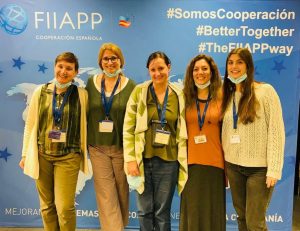
FIIAPP team of the ‘Living without discrimination in Morocco’ project’ Despite legal progress, migrants and refugees remain vulnerable to incidents of racial discrimination. Several civil society organizations have documented cases showing barriers to accessing housing, healthcare, employment, and education for migrant children.
Although authorities combat racism in Morocco, it still affects social inclusion and poses a challenge to the country’s social cohesion.
These racist incidents not only harm victims but also threaten coexistence and the overall well-being of society. As the International Organization for Migration (IOM) has pointed out, discrimination erodes trust in institutions and hinders civic participation.For this reason, in 2014 the Kingdom of Morocco adopted the National Strategy for Immigration and Asylum (ENIA), a pioneering framework that brought migration issues into public policy. Thanks to this strategy, the country has made progress in areas such as education, health, housing, vocational training, and employment.
The “Living Together Without Discrimination” project aligns with ENIA’s goals, particularly those related to fighting discrimination and raising awareness about migration and asylum.The “Living Together Without Discrimination” project
A plural and diverse society has much to gain: social cohesion and collective determination to ensure that racism and xenophobia have no place within its borders. In this sense, projects like “Living Together Without Discrimination” lay the foundation to improve people’s lives through a human rights-based approach, with special attention to the experiences of women in Morocco—particularly migrant women, who may face discrimination based on both gender and origin.
This initiative, promoted by the European Union, the Spanish Agency for International Development Cooperation (AECID), FIAP, and the Spanish Observatory on Racism and Xenophobia (OBERAXE), incorporates a gender perspective essential to understanding multiple levels of vulnerability. According to UN Women, migrant women face greater risks of exclusion and violence, reinforcing the need for gender-sensitive public policies.
The project’s objective has been to strengthen tools and public policies aimed at preventing racism and xenophobia in Morocco, fostering peaceful coexistence free of discrimination.
How it was implemented
Institutional strengthening: Support for developing the technical capacities of public administrations in key sectors such as education, healthcare, justice, and local governance, as well as civil society organizations that play a crucial role in preventing racism and xenophobia.
International cooperation: Integration of collaborative approaches among Moroccan, North African, and European partners, creating a space for dialogue, reflection, and exchange of experiences.
Awareness and media: Launch of communication campaigns and awareness activities alongside journalists and local media to improve migration coverage and combat stereotypes surrounding the migration phenomenon.
Regulatory reforms: Technical assistance to improve Moroccan legislation, reinforce complaint mechanisms, and ensure more rigorous data collection on racial discrimination cases.
International best practices: Promotion of successful experiences from countries such as Tunisia or Spain, serving as references for strengthening migrant inclusion in Morocco.
Dialogue spaces: Creation of consultation forums between civil society and Moroccan public institutions, opening for the first time institutional debates on racism and xenophobia in the country.
It is said that knowledge is the best capital, which is why we are launching a series of publications that bring together all the work done, achievements, recommendations and lessons learned. A total of 14 publications covering the five components of the project shed light on essential issues to address racism and xenophobia in Morocco.
Knowledge and learning
Knowledge is often said to be the best capital. For that reason, the project has produced a series of publications that compile its work, achievements, recommendations, and lessons learned. In total, 14 documents have been developed, addressing the project’s five components and shedding light on key issues for tackling racism and xenophobia in Morocco and strengthening social cohesion.
-
Report on the analysis of international norms and recommendations on combating discrimination, racism, and xenophobia. Identifies international and regional norms (UN, European Union, South America, and Africa) that protect migrants.
-
Comparative study of legislation on racial discrimination, racism, and xenophobia in Spain, France, Tunisia, and Morocco, with proposals to strengthen national protection mechanisms.
-
Analysis of training programs for public administration personnel, based on European experiences in preventing racism, with specific recommendations for Morocco.
-
Study on best practices in communication and awareness in Belgium, Spain, Finland, France, and the Netherlands, to inspire campaigns within the Moroccan context.
-
Training manuals for public administrations and local governments, integrating a gender approach in the fight against discrimination.
-
Report on the intersectionality of discrimination based on race, ethnicity, and gender, analyzing its institutional treatment in Morocco and proposing tools to incorporate this perspective into public policies.
These materials are available in Arabic, French, Spanish, and English, in both full and summarized versions, and can be accessed through the FIAP portal.
-
-
Police officers can develop mental and physical health problems due to the traumas they face during their career. Understanding and learning how to manage stress helps to prevent, recognise or avoid misbehaviour that undermines public trust in law enforcement. How do we address mental health in law enforcement?
Valentina Salvato, project officer of the project Promoting community policing in Lebanon, co-led by the FIIAPP, reflects on the importance of paying attention to mental health in police forces and the action developed by the project through various training courses for this purpose.
Why is this approach necessary?
Being a police officer means being exposed on a daily basis to traumatic events that can endanger their own life: accidents, violence, critical situations and emergencies, natural disasters… All of these entail risks that can affect the mental health of any person. Moreover, we must take into account the current context of Lebanon, a country affected by an unprecedented severe political, economic and financial crisis and a series of traumatic events – the demonstrations of October 2019, the Beirut port explosion in August 2020 and the consequent worsening of the Covid-19 pandemic – which have had a direct impact on the lives of citizens, their behaviour, their psychological stability and their mental health.
How do we address mental health within the security forces?
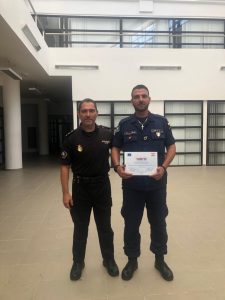
The Chief Inspector of the Spanish National Police and director of the project, Joaquín Plasencia García (left), with one of the Lebanese officers who participated in the training in Aramoun. From the project Support to community policing in Lebanon, we seek to shed light on the issue of mental health in the security forces: a problem that is often ignored, unknown or even rejected. However, the truth is that police officers can develop mental and physical health problems due to the traumas they face during their career. Understanding and learning to manage stress helps to prevent, recognise or avoid misbehaviour that undermines public confidence in law enforcement. As the chief inspector of the Spanish National Police and director of the project, Joaquín Plasencia García, points out, “if a police officer loses the trust of citizens, he loses everything”.
For this reason, we support the Lebanese police in order to implement a preventive and psycho-educational strategy with psychological tools and methodologies to prevent, protect and resolve possible stress situations.
Thanks to the trainings we have offered in Lebanon, such as the last one at the Internal Security Forces Academy (Aramoun), 63 police officers have received tools to prevent and deal with stress situations, conflict resolution, anxiety and post-traumatic stress disorder, depression, anger management or emotion control. This mental health training is also an excellent form of primary prevention, as it increases the knowledge, awareness and resilience of all officers, achieving a direct impact on citizen care, as it reduces and prevents episodes of misconduct in the security forces.
By caring for the well-being of those who care for us, citizens receive better care and service.
-
Peggy Martinello is the Director of Public Administration and Social Affairs at FIIAPP. Part of her work consists of promoting specific migration policies in the world, including this perspective in each of the norms, laws and social policies that are promoted. As a migrant herself, she now reflects on her own experience and on the importance of building and sharing public policies to improve people's lives
I am French and have been living in Spain for almost two decades. I am a migrant, a foreigner, but I have been extremely lucky to have the support of a legal framework that has allowed me to settle, to study, to work, to access the same rights and public services as any Spanish citizen.
Before me, my maternal grandparents also migrated, from impoverished rural Portugal in the 1950s, to a France in full economic expansion after World War II. As did my paternal great-grandparents, who fled fascist Italy in the 1920s. They did not have as many opportunities, neither in their migratory route, nor in their reception, nor in their integration. I am constantly reminded of the importance of institutionality and public policies that, from the territorial space, need to be built and shared with others to improve systems.
Migration is an opportunity and cooperation is an axis for articulating societies and institutions in countries of origin, destination and transit. This decentralised cooperation is a privileged space to contribute to the construction of operational responses to the challenges of human mobility.
There are three elements that seem to me to be particularly important when analysing the reality of migration. These are the multidimensionality of the phenomenon; the need to move away from linear analytical frameworks that associate, for example, economic development in countries of origin with the reduction of migratory movements; and, finally, the importance of policy coherence.
In addition, there is another perspective that I would like to raise: the importance of public technical cooperation, based on the experience of public management, particularly at the territorial level.
I believe that it is particularly relevant to address responses to the challenges of mobility from the territorial level because it is the space of proximity, where attention to migrants, their protection, their inclusion, where diasporas working with countries of origin meet, where public services are connected, where education and training for employment are developed.
In this sense, the role of decentralised cooperation makes a lot of sense, as it can weave around its territorial added value. In other words, local and regional authorities can focus their cooperation on those areas of public management where they have the greatest expertise or experience.
Peggy Martinello. Director of Public Administration and Social Affairs at FIIAPP