-
Education is a key factor in transforming the tax culture in those regions most seriously affected by the armed conflict. We continue our journey with EUROsociAL+ in Caquetá (Colombia)
Participants at the workshop on tax cultureThe National Taxes and Customs Directorate (DIAN) in Caquetá knows that coercion will not get it anywhere, what it needs to do is convince. With only ten auditors, there is no way it can be breathing down every taxpayer’s neck. It needs to build bridges. It needs carrots as well as sticks.
The tax incentives created to promote formalisation and investment must therefore be accompanied by better tax information and assistance for citizens, as well as a good dose of education on the social purpose of taxes and public spending. Teaching children about taxes from an early age can make this process sustainable, and over the long-term, contribute to voluntary compliance with tax obligations.
For several years, the DIAN has been promoting meetings with children and young people on tax culture in schools in Caquetá and it holds tax services events to raise awareness of its role and get closer to the public. New opportunities are arising to consolidate and multiply these efforts through universities in the form of the Tax Assistance Hub project (NAF in its Spanish acronym).
University as a bridge between the DIAN and citizens
Last November, EUROsociAL+ – the European Union’s regional cooperation programme with Latin America – organised a workshop at the University of the Amazon in Florence dedicated to promoting post-conflict tax culture strategies. It was attended by tertiary education institutions and DIAN sections from the Areas Most Affected by the Armed Conflict in Colombia (Zomac).
The University of the Amazon is a unique institution. It is the only public university in Caquetá. It is strongly committed to the peace process, the environment and sustainable development.
Its Public Accounting Programme has joined the post-conflict challenge by creating a Tax Assistance Hub (NAF), an information point where university students give free tax and accounting advice to people with low incomes and micro entrepreneurs.
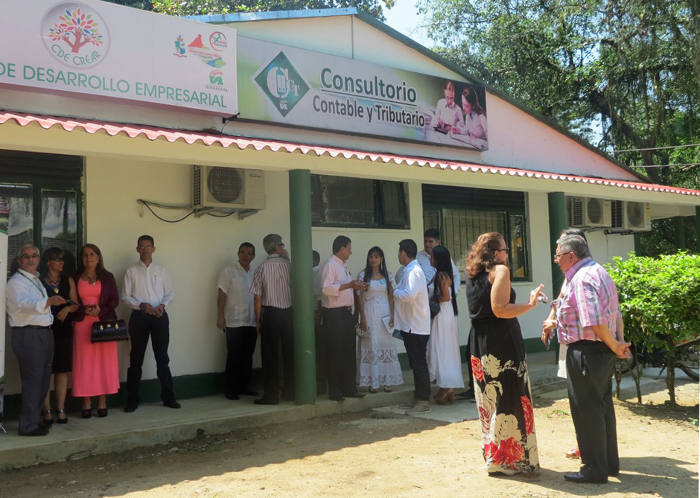
NAF at the University of the Amazon Trained by the tax administration, the students dedicate as much time as necessary to citizens, listening to their problems and concerns. They generate trust and help them understand the tax system and improve their small businesses.
NAFs are a bridge between the DIAN and the public. This experiment, devised in Brazil, is now present in more than 450 universities in 10 countries. In Colombia, 43 universities have joined, 20 of them in ZOMAC areas.
In the past 4 years, EUROsociAL has been supporting the expansion of this initiative by sharing experiences. The workshop in Florencia gave the opportunity to share lessons learned that can be applied to the post-conflict.
Young people as drivers of change
Hernando Vásquez, District Director with the DIAN sees the NAFs as a way for young people to transform the current situation: “The NAFs are an opportunity to generate trust in the tax administration and create civic awareness about taxes. What better way to give future accountants, administrators and lawyers a real view of what is happening?”.
The students attend campus every day and also visit business in Florencia and the surrounding municipalities. This allows them to see the reality of the post-conflict and the opportunities that peace brings for the development of the region.
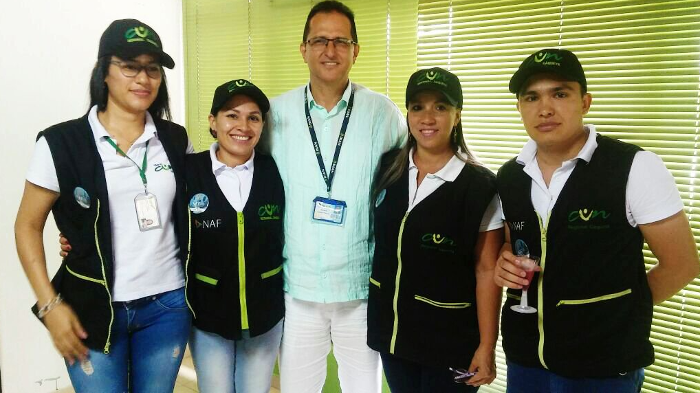
Hernando with students from the NAFs One of the NAF students tells us about their experience: “Caquetá was badly affected by the armed conflict. We now have the opportunity to get to places that were inaccessible until now, and make Colombians from other regions and foreigners see that Caquetá wants to give the best of itself. Paying taxes means contributing to ourselves”.
And the student continues: “Business owners had the excuse that they shouldn’t pay taxes due to the armed conflict. But those excuses are no longer valid. We have gone to NAFs in some of the most difficult places such as San Vicente del Caguán or Cartagena del Chairá, where people are preparing for the law to be enforced more stringently. We need to show what taxes are used for and for farmers or businesspeople to see that taxes build roads to make their work easier”.
This reality is not alien to that of other areas affected by armed conflict, areas that share their experiences at the workshop. Natalia is another of the young people working in the NAFs in ZOMAC areas, in this case in Ibagué: “It’s really rewarding to help someone in need, someone who doesn’t know how to read or write, let alone use a computer, and for them to go away happy with their new knowledge“.
Borja Díaz Rivillas, Senior Expert in Democratic Governance for the EUROsociAL+ Programme
-
We travel to Caquetá (Colombia) with the EU-funded EUROsociAL+ programme. In this first instalment, we find out about the tax culture in one of the territories that has existed for decades on the margins of the state, engulfed in the armed conflict
Arrival in Caquetá (Colombia)Our twin-engine plane touches down in Florencia, capital of Caquetá Department, the gateway to the Colombian Amazon. The storm which preceded our arrival has left the evening bright and clean. The sun melts onto the strikingly beautiful emerald green landscape. Zebu cattle surrounded by white herons, meandering rivers, rice, plantain and cassava plantations, farmers finishing off their working day… A haven of peace and harmony in a land stricken by armed conflict, drug trafficking and poverty.
Caquetá, land of informality
Caquetá lives primarily from livestock and agricultural production. Its 480,000 inhabitants are distributed among 16 municipalities, although the majority of caqueteños live in Florencia, a young city, founded in 1902.
Life in Florencia takes place in the shadow of the underground economy. According to figures by the Bank of the Republic of Colombia, 76 per cent of the working population are informal workers. The weak presence of the State, low quality public services and corruption are fed by deep-rooted practices among citizens, such as tax fraud, violence and a failure to respect public property. The city’s social problems have been accentuated by a massive influx of people displaced by the armed conflict, who account for 60% of the population.
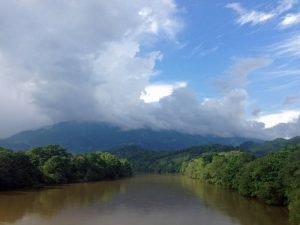
Guayas river “Why pay if they steal it, what is the State giving us? I pay taxes while others thrive by not paying them. It’s not fair”, complain business owners. “There are rich livestock owners who don’t fulfil their tax obligations out of pure selfishness, this way, public services are never going to improve”, one public official told us.
Caquetá Department, just like other areas of the Colombian post-conflict, is caught in a vicious circle that complicates the social contract and the construction of a new framework for coexistence. The reciprocity between the State and citizens and trust between individuals is complicated.
The difficult task of collecting taxes
Being a public official in Caquetá is a challenge, but being a tax collector there deserves a medal. Someone who is only too aware of this is Hernando Vásquez. Hernando came up through the ranks to become the District Director of the Colombian Directorate of National Taxes and Customs (DIAN) in Caquetá: “Many years ago, when I first began working in the tax administration, I was the only auditor in the whole of Caquetá and I noticed real resistance from business owners and taxpayers. I conducted censuses and at times, I feared for my life, I almost had to run away”.
One result of the absence of the State in much of the region was that in many places, people paid a ‘vaccine’, a tax that citizens were made to pay by FARC (Revolutionary Armed Forces of Colombia). Business owners were forced to keep two sets of books in order to pay the extortion, keep their business, and most importantly, keep their family safe. Extortion by paramilitaries was also common.
Sometimes, business owners used armed groups to avoid paying taxes to the State. Hernando tells us that the inhabitants of one town told FARC about the presence of DIAN auditors. Faced with an incursion by guerilla fighters, the public officials had to leave the town in order to save their lives
Carrots and sticks
Although times have changed since the peace agreements between the Government and the armed groups, collecting taxes in this region of Colombia is still complicated, and paying them is not a priority civic duty in the minds of most caqueteños.
The State and DIAN are viewed with suspicion. There is a general lack of awareness about taxation. Many people are forced to work in the underground economy. Those that are aware of their obligations and have the financial means do not pay due to a lack of solidarity. Criminal gangs that benefited from contraband and extortion are still a threat for traders and business owners and of course, DIAN officials.
For taxes to be key in building peace and a more equal society with better public services, it is essential to transform the tax culture of the population and cause a paradigm shift in the relationship between the tax collector and the public.
Álvaro Pacheco, the Governor of Caquetá, is conscious of the need for more reciprocity: “As public awareness increases, so does tax revenue, and we see this reflected in projects that our country really needs, meaning we can advance forwards Paying taxes is nothing to be afraid of”.
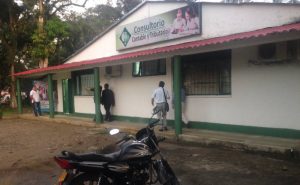
One of the tax advice centres The DIAN in Caquetá knows that coercion will not get it anywhere, what it needs to do is convince. With only ten auditors, there is no way it can be breathing down every taxpayer’s neck. It needs to build bridges. As well as sticks, it needs carrots.
The tax incentives created to promote formalisation and investment must therefore be accompanied by better tax information and assistance for citizens, as well as a good dose of education on the social purpose of taxes and public spending. Teaching children about taxes from an early age can make this process sustainable, and in the long-term contribute to voluntary compliance with tax obligations.
For several years, DIAN has been promoting meetings with children and young people about tax culture in schools in Caquetá, and it holds tax services events to raise awareness of its role and get closer to the public. New opportunities are arising to consolidate and multiply these efforts through universities in the form of the Tax Assistance Hub project (NAF in its Spanish acronym).
Borja Díaz Rivillas, Senior Expert in Democratic Governance for the EUROsociAL+ Programme.
-
The project against organised crime and drug trafficking trains the institutions involved in the country
Training as part of the projectA few weeks ago, the director for Latin America and the Caribbean at EuropeAid, Jolita Butkeviciene, tweeted that “the European Union does not impose programmes, it backs national policies; this is our way of looking at cooperation”.
These statements fit perfectly with the results being achieved in the fight against organised crime and drug trafficking in Peru. This fight is being backed and supported by the European Union in an effective way through a project managed by FIIAPP, as well as additional funding amounting to 32 million euros.
In 2017, our Peruvian partners, whose national policies we back and support, achieved the best ever results in the fight against organised crime. 111 criminal drug trafficking organisations were disbanded, 78 illegal runways for transporting drugs to other countries were destroyed, and 324 cocaine laboratories were burnt down, many of them identified through intelligence work. What’s more, 22,165 hectares of coca leaves were destroyed, preventing the production of up to 204.8 tonnes of cocaine. These results are unparalleled in terms of previous years and denote a clear effort by the new Peruvian administration to improve results in this area.
The project, implemented by FIIAPP, provides training and technical assistance for the main institutions that fight against organised crime and drug trafficking in this Andean country. The Peruvian participants in this project are obtaining very good results and it has been independently verified that they are successfully applying the knowledge and tools transmitted by officials from EU member states to their Peruvian counterparts.
SUNAT Aduanas is one of the institutions being supported by this project, in this case in preventing contraband:
Also worth mentioning is the backing and support the project has given to judicial authorities to successfully resolve big national cases linked to international organised gangs, and the achievements reached in terms of intelligence, such as the creation of the first IT system to manage information to combat organized crime in Peru (SIIETID).
On-demand projects
We live in an interconnected world and cooperation plays an essential role in resolving problems related to transnational organised crime. This influences many areas of the bi-regional European-Latin American agenda.
The problem of drug trafficking must be broken down according to its type and its impact on institutions and people. There is a large difference between a drug producing country and a drug transit or a country that consumes drugs. In Latin America, drug trafficking has a direct effect on the governability of states. The enormous amounts of money moved by organised gangs can be enough to buy governmental structures and destabilise countries—sadly, there are many examples in the region. This is without mentioning the violence it generates and the damage it does to social cohesion. In Europe, there is a deep impact in terms of crime, but it remains primarily a public health issue. Two problems which are interconnected on both sides of the Atlantic.
Through big bilateral projects managed by FIIAPP in Peru and Bolivia and regional projects like EL PAcCTO and COPOLAD, the EU backs policies aimed at combating organised crime and drug trafficking, problems which have such a large impact in both Latin America and Europe. This support is applied through an on-demand method, something which our Latin American partners really appreciate, who praise the EU’s horizontal rather than paternalistic way of working. This is definitely a recipe for obtaining good results.
In fact, this participative working method is one of the hallmarks of the ‘soft power’ approach that characterises EU cooperation. These projects, in which knowledge is shared and long-lasting links between public administrations on both sides of the Atlantic are established, are undoubtedly the best way to achieve results which are sustainable in the long term. In fact, our project has produced contact networks that are already working on researching areas related to transnational organised crime, not only between Europe and Peru but also regionally.
Public safety as a goal
However, we cannot afford to be complacent. The fight against organised crime is polycentered and involves many challenges, such as money laundering and effective collaboration between governments. To improve the quality of life of people in many Latin American countries, we need to make progress in this area as this will have a direct impact on the safety and well-being of citizens. In 2017 alone, 25,000 people were violently killed in Mexico for reasons linked to organised crime, something which should make us think about how to support our partners in the region.
Latin America is a strategic cultural and trade partner for the European Union and as such we need to a have a consistent and improved collaboration policy which helps to optimise the well-being of its population and protect the rule of law. Twenty years since its creation, there is no doubt that FIIAPP is a mature instrument that is well suited to channelling and implementing bi-regional European-Latin American cooperation projects and achieving the excellent results we are now seeing. Let’s not forget that, as outlined in the latest Elcano report, the 2016 European Global Strategy talks about a wider Atlantic space and states that the EU will try to extend cooperation and forge strong links with Latin America and the Caribbean.
Due to its extensive experience and recognition in the region, the Foundation is already a key player in achieving this goal and an important ally of European institutions in empowering the State. This is exactly why we need to keep zealously promoting the results obtained by our Latin American partners. Using facts to demonstrate that as well as strengthening our counterpart institutions on the other side of the Atlantic, more importantly, these actions improve the lives of their people.
Gerard Muñoz, coordinator of the project to fight drug trafficking in Peru
More information on the project in our area on Radio Nacional de España (RNE):
-
The Qudra project helps to alleviate the strain that the war has imposed on this region
The Syrian refugee crisis has been felt in neighbouring countries and particularly in Jordan that, after taking in around 700,000 Syrian refugees, has become the country to accept the second largest number of refugees in relation to its native population.
The majority of the Syrian refugees in Jordan, who are fleeing the armed conflict that has ravaged their country for more than five years, have settled in the border towns in the governorates of Irbid and Al Mafraq, an area that has been the focus of the Qudra project. Only a small proportion of the refugees, around 20%, have been housed in UNHCR camps.
Geographical and human factors are behind the initial concentration of Syrian refugees in the areas of Jordan bordering Syria. The affinity of the peoples on both sides of the Syrian-Jordanian border is not only the result of geography but it is also explained by historical, cultural and even family ties.
Many of the host municipalities have seen their populations swell and with this the demands on services: from the most basic including street lighting and refuse collection to the urban services needed to organise the settlement of the new neighbours and provide the municipalities with basic infrastructure.
The important challenge resulting from the influx of Syrian refugees is not the only one to which the municipalities in northern Jordan have had to respond. In 2015, the Jordanian government launched an ambitious programme of municipal decentralisation that is posing huge challenges in rationalisation and improvement for the local administrations in order for them to deliver greater levels of political autonomy and economic efficiency.
The response of the Jordanian municipalities facing these challenges has included strengthening the management capabilities, particularly in economic and financial aspects, on which the sustainability of public services and the financial autonomy of these administrations depends.
International aid along with the Government of Jordan is accompanying the administrations in this reform process. In particular, and on the initiative of the European Commission, the Madad Fund is funding a number of lines of cooperation aimed at strengthening the local councils in the north of Jordan. The Qudra Project is a part of this programme that is being coordinated by GIZ, a German cooperation agency. It promotes specific activities aimed as strengthening the capacity of the Jordanian municipalities to improve the services they provide and guarantee their financial sustainability. These activities have been entrusted to the Spanish cooperation bodies AECID and FIIAPP. The Institute for Fiscal Studies (IEF), a body at the service of the Spanish Public Treasury that undertakes research and the training of civil servants, has studied the situation and designed cooperation activities and selected a number of expert civil servants.
Sharing of experience
The cooperation strategy is based on the sharing of management experiences between Spanish and Jordanian civil servants. The Spanish experts, in close collaboration with Jordanian civil servants from the municipalities of Ramtha, Sarham and Mafraq, will design and implement reform programmes in the areas of economic and financial management in line with goals primarily defined by indicators relating to financial sufficiency and efficiency in the provision of public services. The experiences gained in undertaking these reforms will be extended to other municipalities in the region and to the entire Jordanian local public sector through training activities. Good practice manuals will also be published that will summarise the experiences gained in carrying out these reforms and the training materials used.
This project represents a valuable opportunity to share the management experiences of the Spanish civil servants with local officials in the Kingdom of Jordan. It will also help to alleviate the weight that the armed conflict has imposed on the region by laying the foundations for improvements in the quality of life of everyone living in these municipalities, refugees and local people alike.
Javier Hernández Pascual. Institute for Fiscal Studies (IFS)
-
The Bridging the Gap project aims to contribute to the effective implementation of inclusive policies for people with disabilities in five middle and low income countries: Burkina Faso, Ecuador, Ethiopia, Paraguay and Sudan
Albert Bock for European Disability and Development Week (EDDW)According to the World Report on Disability published by the World Health Organization (WHO) and the World Bank (WB), disabled people make up 15% of the world population and 80% of these people live in developing countries. These figures make the link between disability and poverty more than evident. However, inclusive development, with its focus on disability, is not yet sufficiently integrated into international cooperation projects.
While developing countries are making great efforts to include the disabled population in the design of their public policies, in practice they still find many difficulties in implementing these policies due to a lack of economic and professional resources.
It is precisely this objective of contributing to the effective implementation of inclusive policies for people with disabilities that Bridging the Gap is pursuing. It is a European Union-funded project to promote the rights and effective inclusion of people with disabilities in five middle and lower income countries (Burkina Faso, Ecuador, Ethiopia, Paraguay and Sudan).
To do this, the project proposes specific actions in each of the beneficiary countries in accordance with the needs raised by public institutions and disability organisations in each country. In Burkina Faso it will focus on improving universal access to health for people with disabilities; in Ecuador, on the right to inclusive education for children with disabilities; in Ethiopia, on promoting an adequate standard of living and social protection for people with disabilities; in Paraguay, on improving the collection and processing of data on disabilities and on promoting inclusive education; and in Sudan on improving universal access to employment for people with disabilities.
The fact that five specific country actions are planned means that it will be possible to obtain visible results and, more importantly, it will allow all the countries to appropriate the results. Bridging the Gap hopes that the good practices generated by this project will be replicable, that they will be taken up thanks to a knowledge management strategy and could be projected at a global transversal level, promoting the mainstreaming of the inclusion of people with disabilities in international cooperation.
The five areas which the project is focussing on are included in the Convention on the Rights of Persons with Disabilities (CRPD), the international instrument for the protection of the rights and dignity of people with disabilities. Article 32 of the Convention establishes that the party States must ensure that all their actions within the framework of international cooperation, including development programmes, are inclusive and accessible to people with disabilities. In addition, the promotion of the rights of people with disabilities is reinforced by the Sustainable Development Goals of the 2030 Agenda for Sustainable Development and the new EU approved European Consensus on Development.
The inclusion of a focus on disability in international cooperation is, therefore, an urgent matter if the Sustainable Development Goals are to be effectively fulfilled and if nobody is to be left behind. Bridging the Gap will work to lay solid foundations to enable it.
The Bridging the Gap project will be officially presented next Tuesday 5 December in Brussels, as part of European Disability and Development Week (EDDW).
Carmen Serrano is the Communication Technician for Bridging the Gap II
-
Today, when corruption has become an endemic evil, we need more than ever to bring the country's institutions closer to its citizens, its legitimate creditors
The Open Government Partnership promotes a culture of transparency and accountabilityToday, when corruption has become an endemic evil that directly affects the democratic quality of our societies, we need more than ever to bring the country’s institutions closer to its citizens, its legitimate creditors. One thing that contributes to closing the gap between the public authorities and the public is undoubtedly promoting a culture of transparency and accountability to bring back the public’s trust in the public administrations.
An interesting initiative along these lines is the Open Government Partnership (OGP) a multilateral initiative involving 69 countries, including Spain and Colombia, that seeks to improve government performance, promote the effective participation of civil society and improve the responsiveness of governments to their citizens.
Each member state of the OGP undertakes to implement multi-year Action Plans that are applicable across the board to their institutions and, in particular, to government powers.
Colombia has demonstrated its commitment to transparency by moving from an “Open Government” to an “Open State” perspective, by including the Judiciary in this initiative. ACTUE Colombia has spent three years working on this initiative in Colombia, giving support to the coordinating body, the Transparency Secretariat, including strengthening the technical capacities of civil society so that they can maintain an effective dialogue with the Colombian government.
The OGP Action Plans are designed to be built with the participation of the different public administrations (General State, Regional and Local Administrations,) and civil society, in which the participation of the public plays an essential role in the development and success of the Partnership.
Spain, which has been a member of the OGP since 2011, has implemented two Action Plans to date, for which civil society demanded more transparency and participation. These demands were included by the National Court in a recent ruling (NCR 3357/2017) in which it recognised the Right of Access of the organisation Access Info Europe, citing for this the case law of the European Court of Human Rights (ECHR 8.11.16 and 25.06.13), which understands this to be a fundamental right that merits a special sphere of protection, so that although in this country the right of access to information has not been recognised as being a fundamental right, in current practice we can speak of a promising situation in this regard.
Similarly, the 3rd Open Government Plan, launched in June this year for the period 2017-19, introduced significant improvements, as recommended by the Partnership’s Independent Review Mechanism (Cooperation, Participation, Transparency, Accountability and Education). It includes proposals from the territorial administrations and ministries, as well as the participation of the public through the public information tool, whereby any citizen can present proposals via the transparency website and monitor all the stages of the 3rd Plan.
A planned new feature will set up a Multi-Sector Forum with representatives from academia, civil society and the public administrations to monitor the 3rd Plan.
Although there is still much to be done to achieve an open state, it seems clear that we are facing a paradigm shift in public policy building in which Access to Information and Transparency, Education in a culture of integrity and progress towards a government in line with these are key elements in making the public an active participant in public decision-making processes and policy building and in contributing to improve the efficiency and effectiveness of our institutions.
Carolina Díaz is a Legal Technician for the European Union Anti-Corruption and Transparency Project for Colombia (ACTUE Colombia)