

19/06/2026
Institutions from all sectors and levels of government involved in international cooperation projects took part yesterday in the fifth edition of the ‘Public Talent Expertise for the World’ event, held at the headquarters of the Ministry of Foreign Affairs, the European Union and Cooperation.
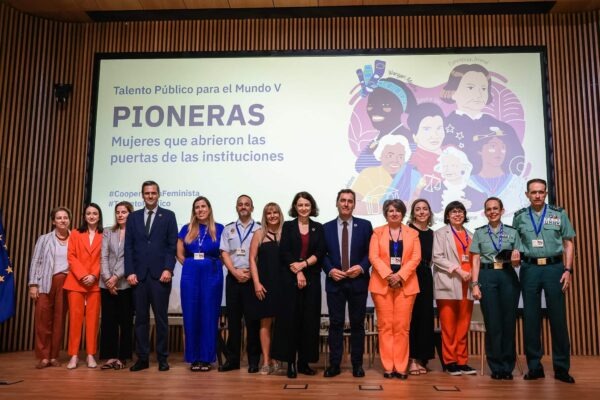
The Foundation for the Internationalisation of Public Administrations (FIAP), which reports to the Ministry of Foreign Affairs, the European Union and Cooperation, brought together around 120 representatives from various institutions on Thursday for the fifth edition of ‘Public Expertise for the World’, an event opened by the Secretary of State for International Cooperation, Eva Granados, which was also attended by the Secretaries of State for the Civil Service and for Security, the President of the Council of State, and the Director of the Institute for Women.
In a year of particular significance for feminist foreign policy (with Madrid hosting the Ministerial Conference on 2 and 3 June) and for feminist cooperation (the strategy for which was presented in January), the event reviewed the contribution that various Spanish institutions can make to the world in the field of feminist cooperation and in advancing women’s access to and role within institutions. The starting point was precisely to highlight the pioneers who opened the door to these institutions for other women, by promoting equal access or by holding decision-making positions within them, including Simone Veil (the first President of the European Parliament), Vijaya Lakshmi Pandit (the first President of the United Nations General Assembly) and Concepción Arenal (an advocate for women’s access to university education in the 19th century).
 The event, held every year to mark International Public Administration Day (23 June), has also highlighted Spain’s contribution to the global debate on public policies for equality and the integration of a transformative feminist approach across various sectoral policies – such as those relating to equality, taxation and the environment – as well as within the justice system.
The first panel discussion, which focused on the leadership role of women in international institutions, featured the Secretary of State for Security, Aina Calvo; the Director of the Institute for Women, Cristina Hernández; the Director of the Spanish Agency for International Development Cooperation, Antón Leis; and a representative of the Association of Women in the Public Sector (Ana María Porras, Manager of the National Institute of Public Administration).
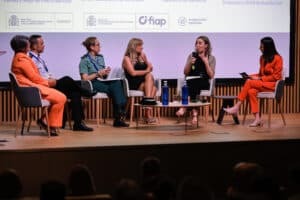
The second panel discussion presented lessons learnt regarding gender issues in FIAP projects, led by representatives from the partner organisations involved in these projects: Mercedes Gómez, Councillor for Sustainable Development at the Regional Government of Castilla-La Mancha; Beatriz Sánchez Álvarez, Senior Prosecutor and Coordinator for Human Trafficking and Immigration at the State Public Prosecutor’s Office; Lieutenant Colonel Verónica Guillén Malagón, Head of the Equality, Diversity and Human Rights Unit of the Civil Guard; Superintendent Javier de Pedro, Head of the Family and Women’s Support Unit of the National Police; and Marga Barceló Fontanals, Head of International Projects and Development Cooperation at Barcelona Provincial Council.
The Secretary of State for the Civil Service, Consuelo Sánchez Naranjo, and the President of the Council of State, Carmen Calvo, also delivered notable speeches. The event was brought to a close by the Director of the FIAP, Francisco Tierraseca.
In 2025, 230 Spanish institutions took part in international cooperation projects with FIAP, working directly with 1,420 administrations in third countries. Almost half of the 83 projects carried out took place in Latin America and the Caribbean, followed by sub-Saharan Africa (26 per cent), the Mediterranean and North Africa (21 per cent) and Europe (6 per cent).
During the year, FIAP mobilised a total of 661 experts (public sector talent) from government bodies. One in four came from autonomous communities and local authorities, representing a 4 per cent increase on the previous year. Security, justice, public finance and social policies were the sectors that accounted for the largest volume of cooperation.