-
We present a series of talks between the European Union and Latin America on cooperation on cross-border crime, in the framework of the European EUROFRONT programme
One morning, a national police station in Spain receives a report of the theft of a vehicle. It was a top-of-the-range Maserati car. The first investigations led to the identification of the modus operandi used by the persons responsible for the theft.
A few days later, there was an increase in reports of the theft of high-end cars (Land Rover, BMW, Mercedes…) in several European countries, where a very similar theft system had been used. This circumstance leads the agents, coordinated through EUROPOL, to believe that they could be dealing with a single organisation. This is a case of organised crime, the definition of which implies that three or more people, over a prolonged period of time and seeking their own benefit or power, commit a series of serious crimes. Collaboration between police authorities allows the keys to be identified in order to bring the case to court.
As the investigation progressed, it was discovered that the vehicles were used to transport drugs in various European countries and that the gang organising the robbery was linked to a large drug trafficking network with a transnational presence. Once certain vehicle models, which are rare in Latin America, have reached the end of their useful life, the network sends them in containers to be sold in the region. Following the trail of the theft and the sale of is helping to unravel the web of connections that the cartel uses to weave the relationships that, to date, have allowed it to circulate its product.
How do connected crimes operate across borders?
The narrative description with which we have opened this article, based on real situations, does not correspond to any known criminal plot. However, this story could well represent a sum of criminal realities whose common factor is the use of borders as a vehicle. Such events are a major challenge for Europe and Latin America. Our objective is, therefore, to give practical expression to a set of complex, supra-regional threats that require the cooperation of multidisciplinary teams (police, judicial, penitentiary, specialised in migration and, above all, in the field of public management).
This is one of the greatest obstacles to the protection of human rights. A complex and multifaceted challenge, which we will unravel through expert voices in a series of video-conversations entitled “Dialogue between regions against border crime” and coordinated by the EUROFRONT programme.
Challenges of cross-border crime and coordination between EU programmes in Latin America
These video-conversations between EU-LATAM experts also involve the heads of four EU-funded programmes promoted by the FIIAPP and its partners, which extends to more than 30 countries in Latin America, the Caribbean and Africa. These colloquia reflect some of the work being carried out in some of these countries, so it is a small sample of the great work of the whole network.
All of them place at the centre of their methodology the exchange between specialists from Europe and Latin America, as equals, favouring the development of mutual capacities and the sum of wills. This is what each of the programme leaders tell us, and how they define their work:
– José Antonio Cambronero (EUROFRONT): “We work to strengthen and streamline border management in seven Latin American partner countries”.
– Agustín Fernández (EL PAcCTO): “This is the first programme that addresses the entire penal chain: police, judicial and penitentiary levels”.
– Manuel Rodríguez (Support Programme for the EU in the fight against drugs and organised crime in Peru): “Our objectives are to strengthen police, judges and prosecutors’ schools, increase inter-institutional coordination and optimise intelligence in the fight against drug trafficking”.
– Alfredo Díaz Sánchez (SEACOP: Programme on illicit maritime trafficking and associated criminal networks): “We are in 29 countries (Latin America, Caribbean and Africa) strengthening training and operational processes”.
Organised crime, drug trafficking and vehicle trafficking
We also had the testimony of representatives from Argentina, Ecuador, Spain and Paraguay who participated in the Regional Meeting on Cross-Border Crime organised by EUROFRONT. As Manuel Rodríguez pointed out at the beginning, “meetings such as the one held are fundamental for the coordination of actions, the human factor is important, as well as meeting and exchanging with the people with whom we will participate in the operations”.
Organised crime
In this dialogue, Álvaro Álvarez Santiago, Chief Inspector of the Itinerant Crime Section of the Spanish National Police, and John Esteban Game Villacis, Undersecretary of Public Security of Ecuador, discuss the challenges and activities that their respective countries are developing in the fight against organised crime.
For example, Ecuador is going to start the accession process to have a liaison officer at Europol, or that Latin America is creating the CLASI (Latin American Committee for Internal Security) to bring together different areas of police coordination. We will also see how various regional organisational actions “have been able to dismantle criminal organisations in several countries simultaneously”, in Álvarez’s words.
In relation to the civilian population’s perception of European cooperation, we would like to highlight Game Villacís’ words: “citizens need action against invisible organised crime and corruption, not just against everyday criminals”.
The conclusions of this block are, in turn, linked to what Alejandro Ñamandú tells us in the following video: “It would be clumsy not to exchange experiences between the different international police agencies”.
Drug trafficking
There is no doubt that drug trafficking is often at the centre of discussions on cross-border crime. In the words of Alfredo Díaz Sánchez, head of SEACOP, “although there are other illicit flows addressed in this programme, the main flow between Latin America and Europe is drugs”.
To broaden our vision in this regard, we attended the dialogue between Juan Antonio Sánchez Jiménez, Chief Inspector of the Central Narcotics Brigade of the Spanish National Police, and Carlos Alejandro Ñamandú, Commissioner General, Superintendent of Federal Investigations and Federal Police of Argentina.
In conclusion, we would like to highlight the words of Alejandro Ñamandú: “Investigation is not an exact science. The exchange of experiences is fundamental to grow as an investigator (…) Criminal organisations are very specialised, they cooperate with each other and that is why police groups worldwide have to collaborate”.
We return to broaden the focus with the fourth and final discussion, because, as Agustín Fernández of EL PAcCTO reminds us, “drug trafficking is not a single crime, it affects other crimes and must be tackled from an integral aspect with joint investigation teams”.
Vehicle trafficking
This is the crime with which we began the article and about which we can now learn more, thanks to the testimonies of Pedro Heriberto Lesme Servín, commissioner in the Department against organised crime of the Paraguayan National Police, and Jorge Carrascal, chief inspector and head of the Organised Crime Section in the Central Unit for Drugs and Organised Crime (UDYCO) of the Spanish National Police.
As Jorge Carrascal tells us, “criminal organisations use vehicle theft as an end in itself, reselling them in other countries to obtain economic profit”. In addition, adds Pedro Heriberto, “there are vehicles with increasingly higher technological quality and this generates new challenges”. Faced with this situation, “some countries may be more advanced in the fight against certain modus operandi, hence the importance of cooperation”, underlines Carrascal.
We see that one of the great challenges is to update the training of agents. Furthermore, as Jorge Carrascal emphasises, “we have to focus on borders, as criminal organisations change countries to make investigation more difficult“. This statement serves as a closing statement for these colloquia, which place the border at the service of the countries working against transnational crime. Among them, the eight EUROFRONT partner countries (Argentina, Bolivia, Brazil, Colombia, Ecuador, Paraguay and Peru), whom we thank for their contribution.
-
We believe in the power of institutions and public policies to create a better world.
Because they are the beginning of change, for more people, for longer.
In a world that no longer understands borders and needs global solutions to shared challenges.
We listen to the demands of countries, opening spaces for dialogue between equals in administrations, learning and offering tailor-made solutions.
We know that our institutions are full of public talent, of people committed to the value of the public sector.
We want their knowledge and experience to flow freely, back and forth, building trust between countries, bringing societies closer together.
We share European values, enriching them with new perspectives.
We mobilise all public sector efforts in this direction: public systems for people and planet.
-
The EUROFRONT programme analyses how training for border officials contributes to security and human rights compliance at border crossings in Latin America
Training of officials in RumichacaThe Rumichaca international bridge over the Guátira River is the main border crossing point between Ecuador and Colombia. Around 1,700 people pass through this area every day. Migration officials have the challenge of identifying in a very limited time whether people trying to enter the country meet the requirements, whether they may be committing a crime, or be victims of human trafficking or smuggling.
Through the European EUROFRONT programme, experts from the Spanish National Police travelled to the city of Pasto (24-28 July) to exchange knowledge with 37 Migration Colombia officials from various regions of the country. The objective of these sessions was to develop their skills in interviewing techniques on the first and second line of the border.
This activity is part of the border management training programme for migration officials from seven partner countries: Argentina, Brazil, Paraguay, Bolivia, Peru, Colombia and Ecuador. Rumichaca is one of the four pilot borders with which the programme is working, along with the Triple Border, Bermejo-Aguas Blancas and Desaguadero. The aim of these actions is to contribute to the security and protection of human rights by strengthening the effectiveness of border management.
Public expertise: Spanish National Police
José María Peche, chief inspector of the Spanish National Police’s Central Border Unit, stresses the importance of the first filter that officials make at checkpoints: “The observation of gestures and attitudes that may indicate certain anomalies, asking key questions that help clarify whether the information is true, are fundamental”. To this end, the trainers have shared with Colombian officials recommendations and protocols that allow them to carry out border inspections in the most efficient manner.
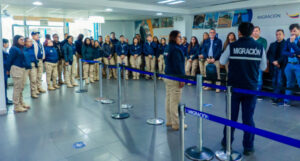
Formaciones a funcionariado de Migración Colombia “The correct application of protocols guarantees that procedures are efficient, that the rights of citizens in transit are respected and that victims of crime can be protected,” adds Peche.
Among the lessons learned are the application of impartiality, the non-criminalisation of the traveller, the acceptance of cultural differences, how to avoid prejudice and discrimination based on religion, sex, ethnicity or any other reason.
First and second line interviews
It must be underlined that frontline border officials have very little time to identify signs that may indicate irregularities. They have on average only 90 seconds to exercise this first filter. With expertise, experience and technique, they must decide whether the indications require further questioning, the so-called “second line interview“, where migration agents have the possibility to verify information.
This is why, experts explain, border interviews are not only about stopping irregular entries or detecting criminal acts. Behavioural observation is crucial for identifying citizens who may be victims of human trafficking or smuggling and facilitating their protection.
Andrés Francisco Mora has been working at the Rumichaca border for four years. The number of people in transit who have passed in front of his window is incalculable. In the words of the expert, “already the behaviour of the travellers in the queues, the gestures or the way people in groups act show that something is not right”. His and his colleagues’ expertise at the counter has made it possible to avoid several cases of minors who were going to be taken out of the country irregularly. “The training is an added value for us that helps us to do our work better,” adds Mora.
Results of cooperation
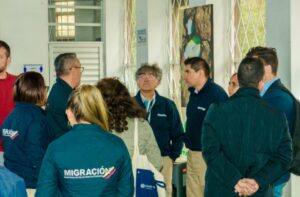
Personal experto de Migración Colombia y FIIAPP en las formaciones In short, the officials have learned how to detect identifiers of a possible victim of trafficking, what questions to ask to verify it, how to ensure respect for the rights of persons in transit and apply the gender perspective, among other contents.
In the last 14 months, around 200 Migration Colombia officials have received face-to-face training in migration management, mainly identification of false documents, or first and second line interviews. In addition, around 1,500 have completed online training on the subject, training that has also been replicated in the rest of the countries with which the Programme works.
Moisés García, Migration Colombia Representative in the Nariño Region (where the Rumichaca border is located) highlighted the importance of the capacity building that officials have been able to receive in the framework of the EUROFRONT programme: “They contribute to reinforce the institutional commitment to make borders safer and more humane”.
-
The FIIAPP is ready to support Global Gateway's renewed commitment to the Euro-Latin American space and the new approach to Latin America
45 000 000 000 (45 billion euros) for Latin America. This was announced on Tuesday in Brussels by the President of the European Commission, Ursula von der Leyen, at the EU-CELAC summit. The meeting comes after eight years as one of the commitments of the Spanish Presidency of the European Union.
The funds will be used to finance digital, climate and energy, transport, health, education and research infrastructures. These priorities are part of the Global Gateway initiative, Europe’s strategy for sustainable and reliable connections to improve the lives of people and the planet. It is the European Union’s bid to position itself in the world.
The FIIAPP and the Spanish Cooperation are part of this effort and we welcome its economic rubric. From FIIAPP we will accompany it with specific projects such as Euroclima and Amazonía+ (on green transition policies), AL-INVEST (on sustainable agricultural trade and exports) or the Digital Alliance (with a specific component on data governance), among others. We will do it the way we know how to do things in our organisation: mobilising public talent from EU Member States’ institutions, establishing horizontal dialogues between counterpart administrations and listening and adapting the implementation of projects to the specific demands of each country. These elements are essential for European-style cooperation, inseparable from the promotion of values such as democracy, the rule of law, social cohesion and multilateralism.
The figure is significant, and the starry ring will now be more visible in many corners of the region, from the Andes to the Amazon and from the Caribbean to Patagonia. But the promised 11 digits will have meaning (and impact) only if three conditions are met:
1) that these investments last over time, 2) that they reach a massive number of people, leaving no one behind and 3) that they are geared towards achieving concrete development results such as access to basic services like justice, education or health, sustainable economic growth, environmental protection or reducing inequality, which are so important in the final stretch of the 2030 Agenda. And this cannot be done by cement or coltan. This is where public institutions and systems come into play, to provide the structures (the hardware) with the necessary software to function: rules, laws and public policies that adequately guide investments, make them accessible to all people, provide for their sustainability and ensure that they fit in with the development priorities of our partner countries.
At the FIIAPP we are ready to support this renewed commitment to the Euro-Latin American space and the new approach to Latin America, one of the European Union’s natural and preferential partners. Beyond trade and investment relations, we are united by solid ties based on our shared values. We have been connecting institutions in the two regions for 25 years. From here, our entire team will continue to work so that, beyond numbers, Europe and Latin America will be a partnership based on values, aimed at tackling shared challenges with a roadmap in the form of a common development agenda.
Specialists of our European cooperation projects assess, from their experience, the importance of public technical cooperation:
“From the European cooperation programme AL-INVEST Verde, we cooperate with Latin American public institutions to promote public policies that facilitate the adaptation of their agro-export sectors to the sustainability standards of the European Union. It is essential that we work hand in hand to build a solid and consistent regulatory framework that encourages the adoption of sustainable practices throughout the production chain. Beyond economic investment, collaboration between European and Latin American specialists generates a comprehensive approach that guarantees the use of best practices for sustainable development”.
Emilio Calvo. Director of AL-INVEST Verde
“Protecting data is protecting rights. In a globalised world, it is necessary that all countries offer the same guarantees when it comes to protecting the data of all citizens. Common public policies avoid fragmentation in the use of data, where people’s rights are most vulnerable. The large multinationals negotiate country by country, looking for where the legislation favours them most, so if there are public policies and common legislative frameworks, all states and regions can speak from the same position with the largest technology companies. People’s rights and freedoms are better protected when the region’s policies are aligned with each other, and if they are also in line with the EU, we will be able to provide more global responses to global problems. To achieve this, in addition to funding cooperation, it must be equipped with expert hands that can work from connected public systems around the world”.
Rosario Heras. Data Governance Expert of the EU-LAC Digital Alliance Support Programme
“The energy transition must be the vehicle to reduce social and economic gaps by ensuring that the benefits are shared equitably. This means taking into consideration the most vulnerable groups such as youth, indigenous communities or women by facilitating their full participation in decision-making. This is why the EU’s Global Gateway Strategy is so vital, as it includes three fundamental pillars for this: research, education and action for climate empowerment.
Elsa Velasco. FIIAPP specialist in the European Euroclima programme
-
La Mauritanie est un point de transit crucial sur la route migratoire du sud vers l'Europe. Le projet européen POC Mauritanie vise à assurer une lutte efficace contre les réseaux criminels impliqués dans le trafic de migrants et la traite des êtres humains
Formation aux techniques d'enquête dans le cadre du projet POC MauritanieLa République islamique de Mauritanie (RIM), située sur la côte atlantique de l’Afrique de l’Ouest, est un pays d’origine et de transit pour les migrations irrégulières vers l’Europe. Bordée à l’est par le Mali, au sud par le Sénégal et au nord par l’Algérie et le Sahara occidental, elle constitue un point de passage privilégié vers l’Europe, notamment en raison de la proximité de son littoral avec les îles Canaries.
En 2020, le nombre d’arrivées en Europe par la route ouest-africaine a considérablement augmenté et, en janvier 2021, les chiffres ont été multipliés par dix par rapport à la même période de l’année précédente. Selon une analyse du Conseil européen, cette augmentation des arrivées est en partie due aux mesures liées au COVID19 adoptées par plusieurs pays africains. Celles-ci semblent avoir entravé les mouvements le long des routes migratoires traditionnelles et détérioré les conditions de vie socio-économiques dans de nombreux pays d’origine.
Les principales villes de Mauritanie
Nouakchott occupe une position centrale dans la région, reliant l’Afrique du Nord à l’Afrique subsaharienne. C’est une ville diversifiée et multiculturelle qui concentre une grande partie de l’activité économique du pays. Nouakchott est devenue un point de transit pour les migrants se rendant en Afrique du Nord ou en Europe et une ville de destination pour la plupart des immigrés mauritaniens. Malgré l’importance économique et commerciale de Nouakchott, peu de statistiques récentes sont disponibles sur la population immigrée de la ville.
Située à la frontière nord de la Mauritanie, la ville de Nouadhibou, avec ses 142 000 habitants, est un centre portuaire et commercial dynamique. Sa position stratégique la rend très attractive pour les nationaux comme pour les étrangers ; en effet, les migrants constituent une communauté importante au sein de la population de la ville. Selon une étude réalisée en 2019 par l’Organisation internationale pour les migrations (OIM), de nombreux migrants viennent à Nouadhibou pour trouver du travail ou parce que la ville côtière est un point de transit privilégié sur la route migratoire vers l’Europe ou les pays d’Afrique du Nord.
Juridiction en Mauritanie
La loi définit la notion d'”entrée irrégulière” comme “le franchissement des frontières pour entrer légalement dans l’Etat d’accueil alors que les conditions requises ne sont pas réunies” et le “crime de trafic illicite de migrants” comme “le fait pour un groupe criminel organisé ou toute autre personne d’assurer sciemment, en vue d’en tirer un avantage financier ou un autre avantage matériel, l’entrée irrégulière d’une personne dans un pays dont elle n’est ni ressortissante, ni résidente permanente”.
La politique migratoire de la Mauritanie à l’égard de l’Union européenne s’inscrit dans le cadre du dialogue politique sur la migration et contribue au suivi des conférences de Rabat et de Tripoli. En outre, la Mauritanie participe au dialogue international sur la migration au sein des Nations Unies. Après avoir signé la Déclaration de New York pour les réfugiés et les migrants en 2016, la Mauritanie a adopté le Pacte mondial pour des migrations sûres, ordonnées et régulières en 2018 et a signé la Déclaration conjointe de Niamey sur le trafic de migrants et la traite des êtres humains la même année. Le pays a également ratifié la Convention de Genève relative au statut des réfugiés du 28 juillet 1951 et son protocole de 1967 en 1987.
Ces dernières années, le cadre juridique mauritanien en matière de migration a été renforcé. Faisant suite au protocole contre le trafic illicite de migrants par terre, mer et air, ratifié par le pays en 2005, la loi n°2010.021 du 15/02/10 portant incrimination du trafic illicite de migrants garantit la protection des victimes du trafic illicite de migrants et renforce la répression des réseaux de passeurs, jusqu’alors relativement à l’abri en raison de la faiblesse des sanctions prévues par le système juridique en vigueur.
Lutte contre la traite et le trafic de migrants
Au niveau régional, le pays facilite la coordination de la lutte contre les réseaux criminels liés à la migration irrégulière le long de la route atlantique. Le 24 décembre 2020, une réunion par vidéoconférence a été organisée, réunissant les ministres de l’Intérieur de Mauritanie, du Mali et du Sénégal, ainsi que le ministre des Affaires étrangères de Gambie. L’objectif de cette réunion était d’analyser les défis posés par la réactivation de la route migratoire de la côte atlantique, en vue de renforcer la coordination et les capacités de lutte contre l’immigration irrégulière et les réseaux de trafiquants d’êtres humains. Cette initiative prévoit l’organisation de réunions mensuelles en 2021.
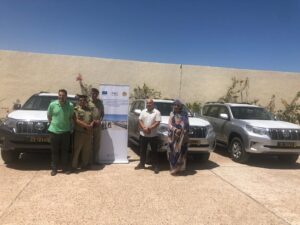
Livraison de véhicules pour les besoins du projet Le Fonds fiduciaire d’urgence pour l’Afrique (FFU) de l’UE finance pour trois ans le projet “POC Mauritanie : Lutte contre la traite et le trafic de migrants illégaux” à hauteur de plus de 4 millions d’euros. L’objectif du projet est d’assurer une lutte efficace contre les réseaux criminels impliqués dans le trafic de migrants et la traite des êtres humains et d’améliorer le contrôle de la migration irrégulière en Mauritanie, un point de transit crucial sur la route du sud vers l’Europe, en particulier via les îles Canaries.
Ce projet européen, mis en œuvre par la FIIAPP avec le concours de spécialistes de la police nationale, vise à améliorer les capacités d’enquête de la police mauritanienne (DST), par le biais d’une équipe conjointe d’enquête médico-légale au sein de laquelle des spécialistes européens accompagneront et encadreront en permanence leurs homologues mauritaniens. En outre, dans le cadre des efforts internationaux visant à améliorer le contrôle de la migration irrégulière tout en respectant les droits de l’homme des migrants, le projet vise également à améliorer la gestion du système de gestion des migrations.
Résultats du projet
Le projet POC Mauritanie mène des opérations conjointes entre la police nationale espagnole et l’Office central de répression du trafic illicite de migrants et de la traite des êtres humains (OCRTIMTEH). En outre, une série de cours de formation, qui constituent l’épine dorsale du projet, sont organisés dans le but de renforcer les capacités des professionnels mauritaniens dans la lutte contre les réseaux de passeurs et de trafiquants. Le projet est pratiquement au méridien de sa mise en œuvre, et pendant cette période, de grandes réalisations ont déjà été faites :
Au niveau opérationnel, 19 opérations ont été menées contre la migration irrégulière. Dix-sept réseaux de passeurs et de trafiquants ont été démantelés au niveau national, et 162 membres de réseaux criminels ont fait l’objet d’enquêtes et ont été arrêtés. Le bureau du procureur a été saisi de 24 affaires de trafic de migrants, dans lesquelles 91 personnes ont fait l’objet d’une enquête. 1254 migrants irréguliers ont été arrêtés en Mauritanie et plus de 500 victimes de trafic et de traite ont été libérées.
En termes de formation et de réunions, 3 réunions de formation ont été organisées sur la coordination de la gestion des migrations et 153 tutoriels pour les agents de l’OCRTIMTEH. Il y a eu 2 réunions pour renforcer la coordination du Centre d’Assistance Temporaire pour les Etrangers (CATE) avec les acteurs étatiques et non-étatiques, et 2 réunions de coordination avec d’autres projets européens au niveau international qui sont menés en Gambie et en Afrique de l’Ouest et du Centre.
-
La Oficina Española de Patentes y Marcas define patente como: un título que reconoce el derecho de explotar en exclusiva una invención. Esto impide a otros su fabricación, venta o utilización sin consentimiento del titular
Today we talk to Pedro Cartagena, industrial property expert at the Spanish Patent and Trademark Office (SPTO) and coordinator of the European cooperation project in Egypt that has been working for two years to improve the Egyptian patent system.
Why is it important to have a patented product?
In a company, whether small or large, it is important to have a patented innovation, because most of the time this patent constitutes the success of your business. Keep in mind that a patent not only gives you a monopoly on the exploitation of what you protect, but also prevents your competitors from commercialising the innovation you have patented. In addition, a patent generally gives prestige to your company and, when necessary, can also become a means of financing. Patents can be sold, or you can allow another company to use them in whole or in part in exchange for an agreed remuneration.
How many innovations are patented each year in Egypt?
About 2,000 patents are applied for in Egypt every year, which is a rather low number considering the population of about 100 million. However, more than the population, what usually influences patent applications is the degree of development of the country and its spending on R&D, as this is what generates innovations, and these innovations could be patented. In the case of Egypt, we are talking about a developing country with a per capita income considered to be medium-low, so it is quite logical that it has this number of applications.
Is it more difficult for SMEs and researchers to patent their innovations?
SMEs and researchers are two completely different sectors, but they have in common that they patent very little. This is mainly because they are largely unaware of both the patent system and the advantages of patenting.
In the case of researchers, they still give priority to publishing the results of their research before applying for a patent, when the two things are completely compatible, if they are done in a synchronised way. In other words, first you apply for a patent and then you can publish the results of your research.
In the case of SMEs, sometimes they don’t even know that they have something they can patent, and they think that it is an expensive and complicated procedure and that it is only for big companies. In the European project we have done with the Egyptian office, we have worked to strengthen the office’s relations with the research community in universities and research centres in Egypt. In addition, we have also established a strategy to bring patents closer to small and medium-sized enterprises and a whole series of informative materials have been developed to inform them of the advantages of patents for their business.
How can the public benefit from an innovation being patented?
The public will generally benefit from any innovation that is commercialised and, on the market, whether it is patented or not. What is important for society is that what the patent system does is to encourage innovation, and by encouraging innovation, new products or processes will be produced that will be innovative and will contribute to the greater well-being of society.
What has been achieved with this project in Egypt and what challenges remain to be addressed?
During these more than two years of the project, beneficial results have been achieved for the Egyptian office in terms of greater outreach to researchers and SMEs, as I mentioned earlier. But in addition to this, more than 50 patent examiners have been trained so that they in turn can train future examiners who join the office and can also participate in giving talks to SMEs and researchers about the patent system and its advantages, which in some way will also contribute to increasing patent applications.
In addition, different work manuals have also been drawn up for some of the departments and units of the office. But perhaps the most important thing, as I also mentioned before, is the achievement of the ISO 9001 2015 certification for quality management systems for companies and institutions. This makes the Egyptian office one of the most relevant offices in the African region.
As for the challenges facing the Egyptian patent office, it is like most patent offices in the rest of the world, which is basically to ensure that small and medium-sized companies integrate a patent culture into their business strategies, that they patent more, and that these patents are also of high quality.
What do you bring back to Spain both professionally and personally?
As a professional, during this time I have learned a different way of working and of approaching things and problems, since living in Spain we don’t realise that in general, in the European Union, everything is standardised and if you move from one country to another there are no major differences in terms of developing your professional activity.
However, when you arrive in Egypt, although it is a country that in your normal life is not excessively different from what you are used to, because it is a Mediterranean country, on a professional level you do notice a lot of differences.
On a personal level, I have brought back an incredible experience, and, above all, I have realised how privileged we are to have practically everything and sometimes even more than we need, not only to develop our professional activity, but also for our personal life.