


22/05/2026
For three years, security forces from Ghana, Kenya and Senegal have been sharing experiences on protecting public spaces against terrorist attacks.
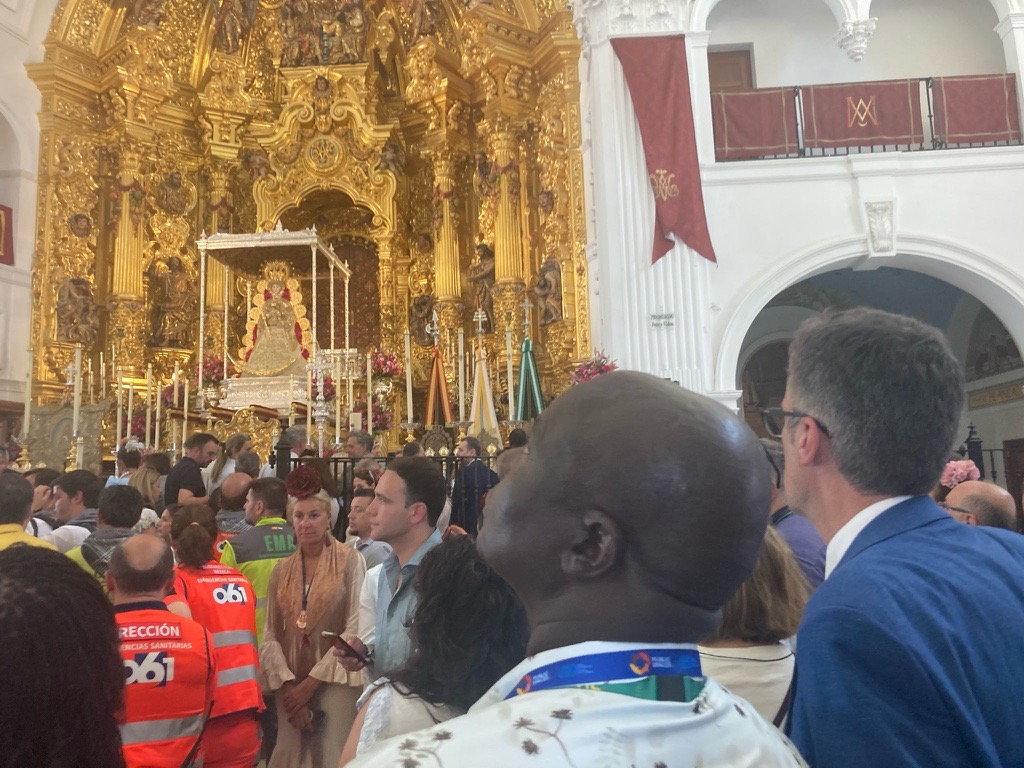
One of the key activities of the Public Spaces+ project is getting underway in Almonte. This project involves sharing knowledge and experience with three key countries in regions affected by international terrorism: the Horn of Africa, the Sahel and the Gulf of Guinea.
Over the course of three days, a Kenyan delegation will visit various points of the Civil Guard’s security deployment during the Rocío festival, such as the command and control centre, the UAR counter-terrorism unit, the unmanned aerial vehicle (UAV) and anti-UAV units, the communications centres, the K9 units with dogs trained in explosives detection and intervention, the media centre and other tactical and uniformed deployments.
The visit is being accompanied by members of the Civil Guard’s counter-terrorism units, a representative of the European External Action Service and the director of the FIAP.
In April, a delegation from Senegal was able to observe a similar operation at the Spanish MotoGP Grand Prix in Jerez, and this July, representatives from Ghana will be present at the Benicàssim International Festival (FIB).
The Civil Guard will round off this direct exchange of experiences by supporting security management at events in Africa such as the Youth Olympic Games (Dakar, 2026), the Africa Cup of Nations (Kenya, Tanzania and Uganda, 2027) and Ghana’s National Day. These are high-profile events attracting massive crowds in three of the countries hardest hit by international terrorism.
The theoretical and practical training courses, which will subsequently be rolled out to around 500 members of the security forces in these countries, will take place between 2025 and 2028 and cover topics such as risk analysis and control in the use of UAVs (drones), police medical assistance, tactical rescue operations, the handling of explosive detection and intervention dogs, as well as sniper training. All training courses incorporate a specific focus on human rights, gender equality and the rule of law.
The project, funded by the European Union’s Foreign Policy Instrument (FPI) with six million euros, forms part of the EU Security Strategy.