
08/05/2026
Drug trafficking, corruption and human trafficking are crimes that in turn give rise to money laundering, a crime that allows money derived from such offences to be channelled into the economy.
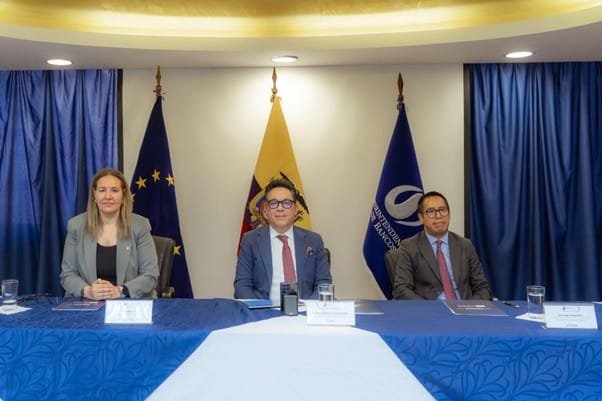
Cristina Lera, Director of SERPAZ; Roberto Romero Von Buchwald, Superintendent of Banks; Santiago Requelme, Coordinator of the Anti-Money Laundering Unit at the Attorney General’s Office.
With the aim of overcoming the security crisis linked to drug trafficking and organised crime in Ecuador, the European SERPAZ programme – the Security, Hope and Resilience for Peace in Ecuador programme – is currently being implemented.
As part of this programme, a training session has been organised with the aim of strengthening coordination between institutions and improving the exchange of financial information, so that unusual transactions are not only detected but can be turned into solid evidence to enable the prosecution of any cases that arise.
The meeting, entitled ‘Operational Synchronisation: Strengthening the Flow of Financial Intelligence for the Fight against Money Laundering’, has served as a technical forum bringing together representatives from the financial sector, supervisory bodies and the judiciary.
The Superintendent of Banks, Roberto Romero Von Buchwald, has highlighted the importance of improving coordination between key players in the system and stated: “The fact that we are gathered here today demonstrates a shared determination to do the right thing and strengthen our joint efforts.”
For her part, the director of SERPAZ, Police Commissioner Cristina Lera, seconded by the FIAP, emphasised the programme’s strategic focus: “Security and social peace cannot be consolidated without coordinated action against criminal economies. The challenge that brings us together at this meeting is to work with technical rigour, agility and a shared commitment in the face of organised crime.”
In the same vein, the coordinator of the Anti-Money Laundering Unit at the Attorney General’s Office, Santiago Requelme, emphasised the value of information in criminal proceedings: “Institutional strengthening depends on improving the quality and flow of information we receive from the financial system. Only in this way can we transform data into solid investigations, increase the number of cases brought to court and make progress in dismantling economic structures linked to crime.”
Durante el proceso formativo se han llevado a cabo mesas redondas que han permitido analizar casos prácticos y tipologías de lavado de activos, así como ejercicios colaborativos para identificar obstáculos en el intercambio de información y proponer soluciones concretas.
Para conseguir esa mejora en los flujos de información se prevé generar una guía con criterios unificados para poder realizar los reportes financieros, la creación de un directorio operativo con enlaces interinstitucionales y, también, identificar cuáles son los nudos críticos que actualmente afectan al flujo de información.
Estas acciones se enmarcan en el fortalecimiento de la coordinación entre la Unidad de Análisis Financiero y Económico (UAFE), las instituciones financieras y la Fiscalía General del Estado, lo que va a contribuir al cumplimiento de estándares internacionales y al desarrollo de un sistema más eficiente de detección y sanción del delito financiero.
El Programa SERPAZ continuará impulsando espacios de articulación, asistencia técnica y fortalecimiento institucional, orientados a mejorar la respuesta del Estado frente al crimen organizado. La Unión Europea reafirma así su compromiso de acompañar al Ecuador en el fortalecimiento de sus instituciones, promoviendo respuestas coordinadas, técnicas y eficaces frente a los desafíos del lavado de activos y la criminalidad organizada.
El programa europeo está liderado por España a través de la FIAP y cuenta con la colaboración de Francia (Expertise France – EF), Italia (Organización Internacional Latinoamericana – IILA), FEDEXPOR & CORPEI, junto a los puertos de Amberes y Rotterdam y GIZ desde Alemania.