
29/10/2026
Guatemala’s Ministry of Environment and Natural Resources (MARN), with the support of the European Union, has presented this strategic tool to strengthen people’s ability to understand, engage with and take action on the challenges of climate change.
The National Strategy for Climate Empowerment (ENACE) 2026–2035 sets out a roadmap to strengthen climate education, public participation and access to climate information, fostering a more resilient and inclusive society in the face of climate change.
ENACE is the result of an extensive participatory process led by the Ministry of Environment and Natural Resources (MARN), with the support of the European Union through the Euroclima programme, implemented by the Foundation for the Internationalisation of Public Administrations (FIAP) under the Global Gateway strategy. Its development brought together contributions from public institutions, local governments, Indigenous Peoples’ associations, women’s organisations, youth groups, academia, the private sector, civil society and international cooperation partners.
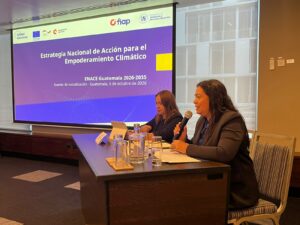 The strategy aims to strengthen six key areas of climate action: education, training, access to information, public awareness, citizen participation and cooperation. It seeks to foster an informed and engaged public, actively involved in developing sustainable solutions.
The main outcomes of the process include defining a national vision for climate empowerment up to 2035, prioritising actions to strengthen climate governance, and establishing mechanisms to enable more effective participation by women, Indigenous Peoples, young people and other historically excluded groups.
ENACE also incorporates human rights, gender equality, interculturality, intergenerational equity, universal accessibility and recognition of ancestral knowledge. These approaches are essential to ensuring that climate action reflects Guatemala’s cultural and territorial diversity.
Edwin Castellanos, Minister of Environment and Natural Resources, said:
“At MARN, we are promoting climate action that puts people at the centre and creates more opportunities for them to participate in finding solutions. ENACE allows us to move forward in this direction by strengthening the participation of women, Indigenous Peoples and young people, and recognising their knowledge and experience as an essential part of the decisions we make for Guatemala.”
With this strategy, Guatemala is making progress towards meeting its national and international climate commitments, including the Paris Agreement and the Glasgow Work Programme on Action for Climate Empowerment, while strengthening the conditions for greater resilience and adaptation in its most vulnerable territories.
The support provided by the European Union and FIAP through Euroclima is part of broader cooperation to support Guatemala’s environmental and climate efforts. In this context, ENACE complements other initiatives under the Global Gateway Investment Agenda, including the programme to promote the green transition in Petén and the programme for the comprehensive recovery of the Motagua River basin.
The launch of ENACE marks a decisive step towards more inclusive, participatory and effective climate action, placing people and their capacities at the heart of the response to the climate crisis.
The full document is available here.