

16/11/2026
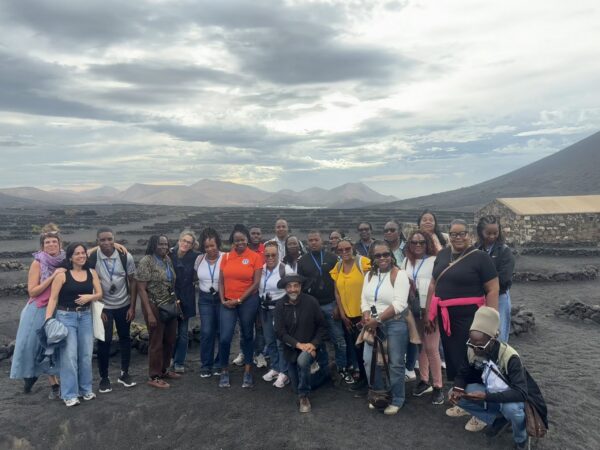
From 8 to 13 November, representatives of six Member States of the Organisation of Eastern Caribbean States (OECS) took part in a study visit to Lanzarote and Gran Canaria. The visit was organised under the European Union’s EU-CaN project and focused on how to link local production with school meals and healthy, sustainable diets.
Island territories face very similar challenges in building resilient, inclusive food systems that connect local farming and fishing with public procurement and school meals. The Canary Islands and the Caribbean share this reality: limited land and water, heavy reliance on imported food, vulnerability to climate change and small local markets.
With this in mind, a delegation from six OECS Member States and the OECS Commission travelled to the Canary Islands to learn about experiences and public policies that address these challenges, identify good practices and explore how they might be adapted to the realities of the Eastern Caribbean.
The visit is part of the European Union’s Global Gateway EU-CaN project, led by FIAP/Spanish Cooperation. It was carried out in collaboration with the Canary Islands Government’s Institute for Agri-Food Quality (ICCA) and the OECS.
The delegation was made up of representatives from the ministries of Health, Agriculture and Fisheries, and Education of Antigua and Barbuda, Dominica, Grenada, Saint Lucia, Saint Kitts and Nevis, and Saint Vincent and the Grenadines. Organisations working on public policy and awareness-raising around food and nutrition also took part, including the Grenada Food and Nutrition Council, Lake Health and Wellbeing and the Zero Hunger Trust Fund.
On the Canary Islands side, partners included the Government of the Canary Islands (through its departments of Agriculture, Livestock, Fisheries and Food Sovereignty, and of the Environment), the Island Councils of Lanzarote and Gran Canaria, and IPNA-CSIC.
José Juan Pérez Suárez, Island Director for Water Security at the Gran Canaria Island Council’s Department of Agriculture, Primary Sector and Livestock, said:
‘Island territories, which are extremely dependent on the outside world, need food sovereignty. With that goal of independence, of achieving food sovereignty, in mind, the Gran Canaria Island Council is working hard to make sure certain products can guarantee our self-sufficiency.’
Constanzza Sermeño Rosales, EU-CaN Programme Coordinator at FIAP, noted:
‘The real value of this visit is seeing that the challenges we share as island territories can also be tackled through common solutions. It’s not about transferring models from the Canary Islands to the Caribbean, but about identifying experiences that can be adapted to each country. Through EU-CaN, we want to strengthen the links between agriculture, health and education so that local production contributes to healthier, more sustainable and more inclusive diets.’
Roxanne Brizan-St Martin, Programme Director of Health, Social Inclusion and Social Protection of the OECS Commission added:
‘Addressing food and nutrition security in our region requires confronting the realities of our shared structural vulnerabilities. This study tour demonstrates the tangible value of our regional integration agenda: by pooling knowledge and breaking down traditional silos between agriculture, health, and education, it contributes to building stronger national and regional capacity.’
The visit began in Lanzarote, where the delegation saw how this very arid island, with limited resources, has developed farming systems adapted to water scarcity, volcanic soils, strong winds and very little arable land.
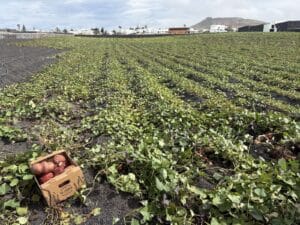 Examples include the jable sand-based cultivation systems and the sand-mulched vineyards of La Geria, which form part of the Globally Important Agricultural Heritage Systems (GIAHS) recognised by the FAO. The delegation also learnt about SAT El Jable, a producers’ collective that promotes organic farming, cooperation between farmers and the sustainable use of local resources.
In Gran Canaria, the delegation visited AIDER Gran Canaria, among others. This local action group supports the island’s rural development through a public–private governance model. One of its initiatives is the Land Bank, a programme that identifies unused farmland and brings it back into production, while also encouraging a new generation to take up land-based professions.
The delegation also took part in exchanges on local value chains, sustainable production, efficient water management, innovation and territorial cooperation.
As part of this, they learnt about three projects funded by the European INTERREG MAC Territorial Cooperation Programme, which promotes collaboration between the Macaronesian territories (the Azores, the Canary Islands, Cabo Verde, Madeira and the Savage Islands) and participating African countries: Alsemac, which focuses on promoting the responsible production and consumption of safe, healthy and sustainable food within a circular economy; IDIWATER, run by the Canary Islands Institute of Technology (ITC), on innovation in agricultural water management; and Ecotúnidos. All three connect producers, public institutions and local communities.
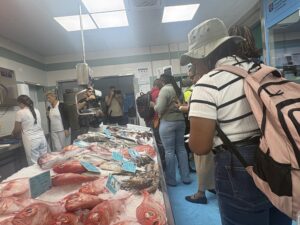 The delegation also visited the Melenara Fishermen’s Cooperative. With support from the European Ecotúnidos project, promoted by the University of La Laguna with the ITC as lead partner, the cooperative encourages local people and school canteens to eat fish from local small-scale fisheries.
One of the central themes of the visit was how to link local farming with school feeding and the promotion of healthy diets.
The delegation learnt about the Canary Islands’ Ecocomedores programme, which brings together organic producers, schools and public institutions to put fresh, local, seasonal food on school canteen menus.
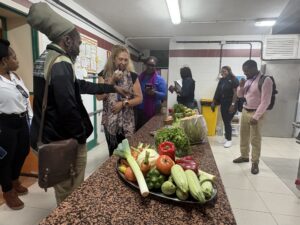 During a visit to CEIP San José Artesano primary school, the delegation saw how purchasing, logistics and the supply of organic, locally sourced food are organised for a school canteen, as well as the role of food education and awareness-raising within the school community. They also learnt how producers, collection centres and schools organise themselves to work together.
This exchange was particularly relevant for the Eastern Caribbean States, which are working to strengthen their nutrition policies, promote healthy school environments and build links between local agriculture and school feeding programmes.
The visit was designed as an opportunity for applied learning and knowledge transfer. Its aims were to strengthen national and regional capacity to promote healthy diets and nutrition, support public policy and school feeding processes, encourage the economic and social participation of women and young people in the agri-food and fisheries sectors, and strengthen Eastern Caribbean food systems through the support EU-CaN provides in the region.
📸You can follow the tour on FIAP’s Instagram and Facebook pages.