


01/10/2026
Data protection, secure international data transfers, artificial intelligence and legal certainty for investment were among the main topics discussed by more than 100 representatives from the EU, Latin American and Caribbean.
Every day, people share personal data when accessing public services, receiving healthcare, shopping online, travelling or simply using a digital platform. As more services and economic activities move online and across borders, ensuring that data can flow safely, while protecting people’s rights and building trust in digital technologies, has become increasingly important.
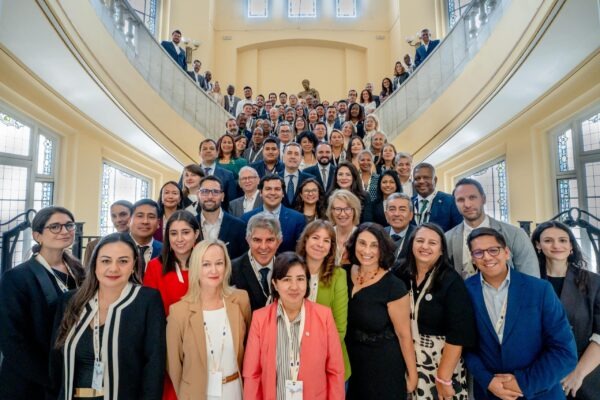
Against this backdrop, Madrid hosted this week the 2nd EU-LAC High-Level Policy Dialogue on Data Governance, bringing together digital policymakers and personal data protection authorities from the European Union, Latin America and the Caribbean. Participants came from 22 LAC countries – Argentina, Bahamas, Belize, Brazil, Chile, Colombia, Costa Rica, Dominican Republic, Ecuador, El Salvador, Grenada, Guatemala, Guyana, Honduras, Jamaica, Mexico, Panama, Paraguay, Peru, Republic of Suriname, Trinidad and Tobago and Uruguay – and eight EU Member States – Croatia, Finland, Hungary, Malta, Poland, Slovenia, Estonia and Spain – together with representatives of the European Commission (DG INTPA). Regional and international organisations and development banks included CTU, ECLAC, CARICOM, SICA, the Council of Europe Data Protection Unit, SEGIB, OAS, UNESCO, OECD, ITU, the European Data Protection Board and IDB. The Dialogue also brought together civil society, academia and the technical community (Open Data Charter, Universidad de los Andes, CENIA, Universidad Católica de Colombia, IPANDETEC and Fundación Datalat), the private sector (Zetes, IAB Spain, ISMS Forum, Acciona, Farmindustria and Telefonica), and cooperation and implementing agencies (FIAP, Expertise France, GIZ, eGA and AECID).
The dialogue provided an opportunity to take stock of progress achieved under the project “EU-LAC High-Level Policy Dialogue on Digital Policy and Regulation” and, above all, to identify concrete areas in which the two regions can work together to turn common principles into practical solutions.
Organised by the Fundación para la Internacionalización de las Administraciones Públicas (FIAP) and Uruguay’s Regulatory and Personal Data Control Unit (URCDP/AGESIC), in the framework of the European Union’s EU-LAC Digital Alliance and Global Gateway initiative, the Dialogue further strengthened bi-regional cooperation on data governance. The discussions focused on how sound regulatory frameworks, capable institutions and mechanisms enabling trusted data exchanges can contribute to a digital transformation that works for citizens, public administrations and businesses alike.
Participants from the European Union, Latin America and the Caribbean exchanged experiences and priorities on the challenges and opportunities associated with data governance in an increasingly digital society.
For citizens, effective data governance is ultimately about trust: knowing who can access their personal information and for what purpose, being able to use digital services with confidence, and ensuring that new technologies develop without compromising fundamental rights. For public administrations and businesses, compatible and predictable rules can make it easier to develop digital services and cooperate across borders.
The discussions highlighted the importance of regional cooperation networks, with particular attention to the role of the Ibero-American Data Protection Network (RIPD), as well as the need for strong governance frameworks underpinning trusted data spaces and mechanisms for secure international transfers of personal data.
 FIAP Director Francisco Tierraseca stressed the importance of the meeting “not only because of the value of direct cooperation between public administrations, but because it provides momentum to move from policy dialogue to concrete action”.
 Lorenzo Cotino, President of the Spanish Data Protection Agency (AEPD), noted that artificial intelligence increases the capacity to extract value from data, but also the scale, speed and depth of the risks. “The AEPD’s response combines supervision, prevention, responsible innovation, the generation and exchange of knowledge, and cooperation with other authorities,” he added.
As AI becomes increasingly present in services used by citizens, public administrations and companies, participants discussed the need for clear regulatory frameworks and safeguards capable of protecting individuals while allowing innovation to thrive.
The exchanges addressed how principles such as transparency, accountability and protection of personal data can help make AI systems more trustworthy and ensure that technological progress goes hand in hand with respect for people’s rights.
The Madrid Dialogue builds on previous EU-LAC exchanges aimed at turning policy cooperation into practical results. Earlier discussions under the EU-LAC Digital Alliance identified areas such as cross-border interoperability, electronic identification and digital signatures as opportunities for concrete bi-regional cooperation.
This work reflects a broader objective: making it easier and safer for citizens, administrations and businesses to interact digitally across borders. Common or interoperable approaches can help simplify procedures, improve access to digital services and reduce unnecessary administrative barriers, while maintaining high levels of data protection and security.
Data governance also has a strong economic dimension and is closely linked to the European Union’s Global Gateway investment strategy.
Data have become a strategic asset for companies of all sizes. Yet businesses are more likely to invest, innovate and develop digital services when they understand the rules governing how data can be accessed, used and transferred.
Participants therefore discussed how clear, transparent and predictable frameworks can reduce uncertainty and regulatory barriers, create greater legal certainty and support investment and business opportunities between the European Union, Latin America and the Caribbean.
This connection between regulation and investment is particularly important for the EU-LAC Digital Alliance: digital infrastructure and innovative services can deliver their full benefits only when they are supported by trusted rules, capable institutions and an environment in which citizens and businesses feel confident using them.

The Dialogue concluded with the identification of shared priorities to guide the next stage of EU-LAC cooperation on data governance. Among the main takeaways were the need to strengthen interoperability and standardisation, improve data quality, and move from existing regulatory frameworks to effective implementation, including by identifying implementation gaps and developing practical frameworks for data sharing and international transfers, such as Standard Contractual Clauses. Participants also highlighted the value of common governance approaches, trusted networks and a shared basic language to facilitate cooperation, alongside stronger institutional capacities and specialised knowledge.
Other priorities included investing in secure technological infrastructure and cybersecurity, translating standards into effective implementation, and advancing technological sovereignty through people-centred solutions and human oversight in artificial intelligence. Participants also stressed the importance of enabling countries in the Global South not only to consume digital services, but to create value and services from the data they generate.

The Madrid meeting therefore marks another step towards a shared digital space built around trust: one in which personal data are protected, new technologies can be used responsibly, businesses can operate with greater certainty, and citizens on both sides of the Atlantic can benefit from safer and more reliable digital services.
Through the EU-LAC Digital Alliance, the European Union, Latin America and the Caribbean will continue working to translate policy dialogue into concrete cooperation and practical solutions for an increasingly interconnected digital world.