


03/11/2026
Criminal governance, institutional resilience and the consolidation of the EU–LAC cooperation architecture are at the heart of the discussions, which will conclude with strategic recommendations for the 2027–2030 period.
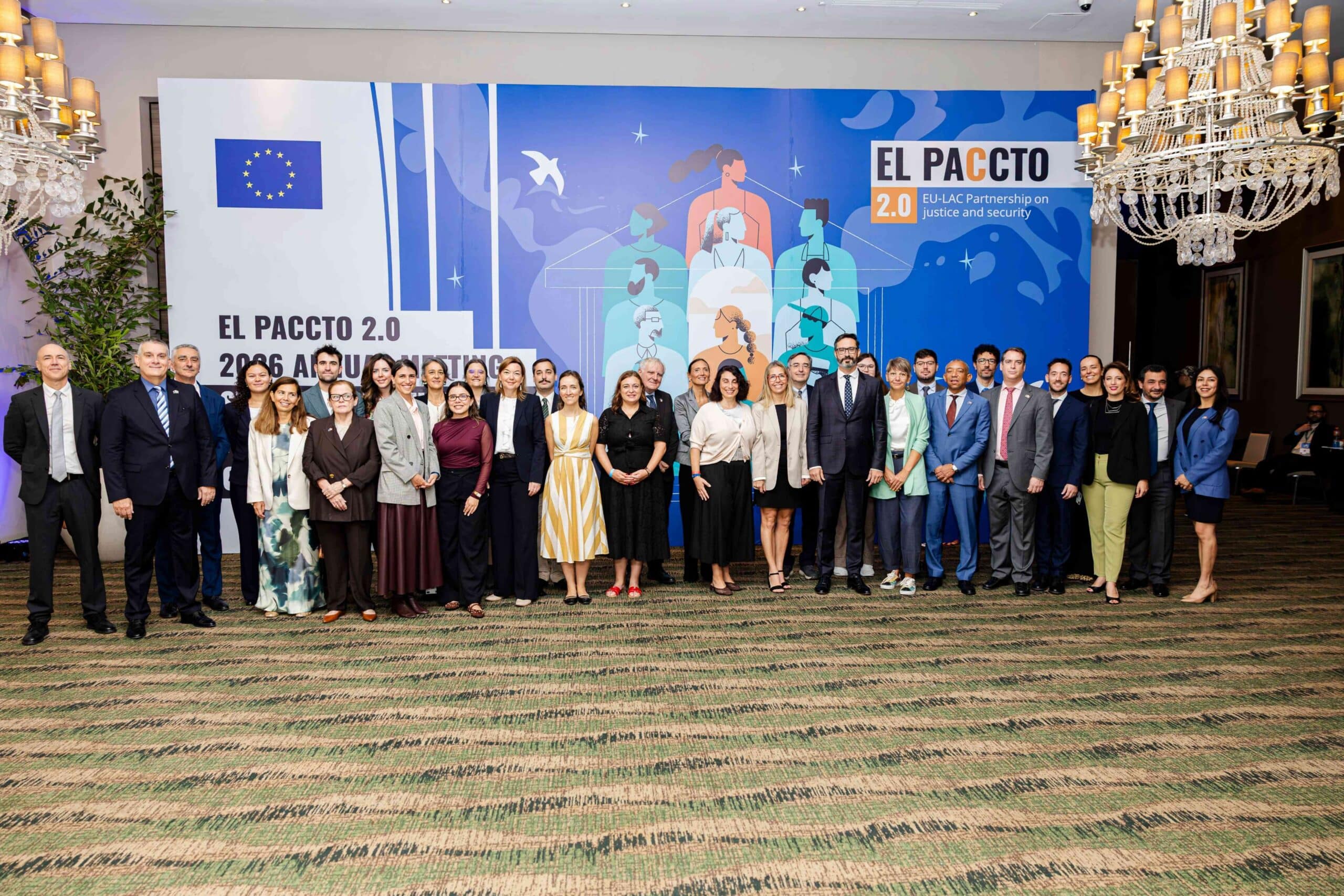
EL PACCTO 2.0, the European Union’s programme for cooperation with Latin America and the Caribbean in the fight against transnational organised crime, held its 2026 Annual Meeting in Santo Domingo from 13 to 15 October, under the motto “Strong institutions, resilient societies: together against transnational organised crime.”
Over three days, representatives of justice and security institutions from Latin America, the Caribbean and the European Union met with international organisations such as INTERPOL, regional networks such as AMERIPOL and various European agencies and institutions to take stock of the programme’s progress and define priorities for the coming years.
The opening session featured Antoliano Peralta, Minister of Justice of the Dominican Republic; Yeni Berenice Reynoso, Attorney General of the Republic; Faride Raful, Minister of the Interior and Police; and Raúl Fuentes Milani, Ambassador and Head of the European Union Delegation to the Dominican Republic. Silvia Viceconte, from the European Commission, and Javier Samper, Director of EL PACCTO 2.0, then presented the main themes and objectives of the meeting.
The high-level dialogues brought together representatives from the European Union and Latin America and the Caribbean, including José de la Mata, Vice-President of EUROJUST; Monika Maglione, European Coordinator for the Fight Against Drug Trafficking; Garth Wilkins, Minister of Justice of Saint Kitts and Nevis; and Peter Maldonado, Vice-Minister of the Interior of Bolivia. Representatives from the six European agencies implementing the programme also took part.
The meeting builds on the networks meeting held in Montevideo in July. While that meeting focused on operational cooperation and connecting networks, the Santo Domingo gathering provided a strategic perspective on institutional priorities for the coming years.
The meeting was structured around three main areas. The first was criminal governance, examining how criminal organisations have expanded their influence beyond the trafficking of illicit goods to exert territorial control, regulate local economies and manage logistics chains. The aim is to identify institutional tools capable of sustainably undermining their business models.
The second area was institutional resilience. Beyond law enforcement and repressive capacity, discussions addressed how to prevent infiltration and corruption, protect justice practitioners and vulnerable communities, and curb the recruitment of young people by criminal networks.
The third focused on cooperation between the European Union, Latin America and the Caribbean, with particular attention to strengthening and connecting structures such as CLASI, AMERIPOL, CARICOM IMPACS, the Regional Security System, EUROJUST and EUROPOL, ensuring their continuity and operational capacity beyond the programme’s direct support.
The meeting concluded with strategic workshops in which participants developed recommendations to guide EU–LAC cooperation on justice and security for the 2027–2030 period, while identifying national priorities and pilot initiatives.
EL PACCTO 2.0 is the European Union’s programme for cooperation with Latin America and the Caribbean in the fight against transnational organised crime. Funded by the EU, it supports institutions in both regions across the entire criminal justice chain — law enforcement, judicial, prosecutorial and penitentiary systems — through an approach based on partnership between equals. It also supports the creation and consolidation of operational cooperation networks and structures.
The programme is led by FIAP and implemented by a consortium of European agencies comprising Expertise France and CIVIPOL (France), Camões (Portugal), the International Italo-Latin American Organisation (IILA) and the Ministry of Foreign Affairs of the Netherlands.