


20/07/2026
Ghana shares its experiences of protecting public spaces from terrorist attacks at the Benicasim International Festival.
With a history stretching back over 30 years, the Benicasim International Festival (FIB) is one of the region’s leading music festivals, attracting an average of between 20,000 and 30,000 people a day. This influx of people presents a security challenge, requiring a total deployment of 900 officers. These include traffic units, the Reserve and Security Group, a helicopter, an intelligence unit, the judicial police, the maritime service, the Mounted Police Unit and the Rapid Action Group (GAR), which is responsible for counter-terrorism operations. The deployment includes drone and anti-drone systems, as well as its PEGASUS air coordination units.
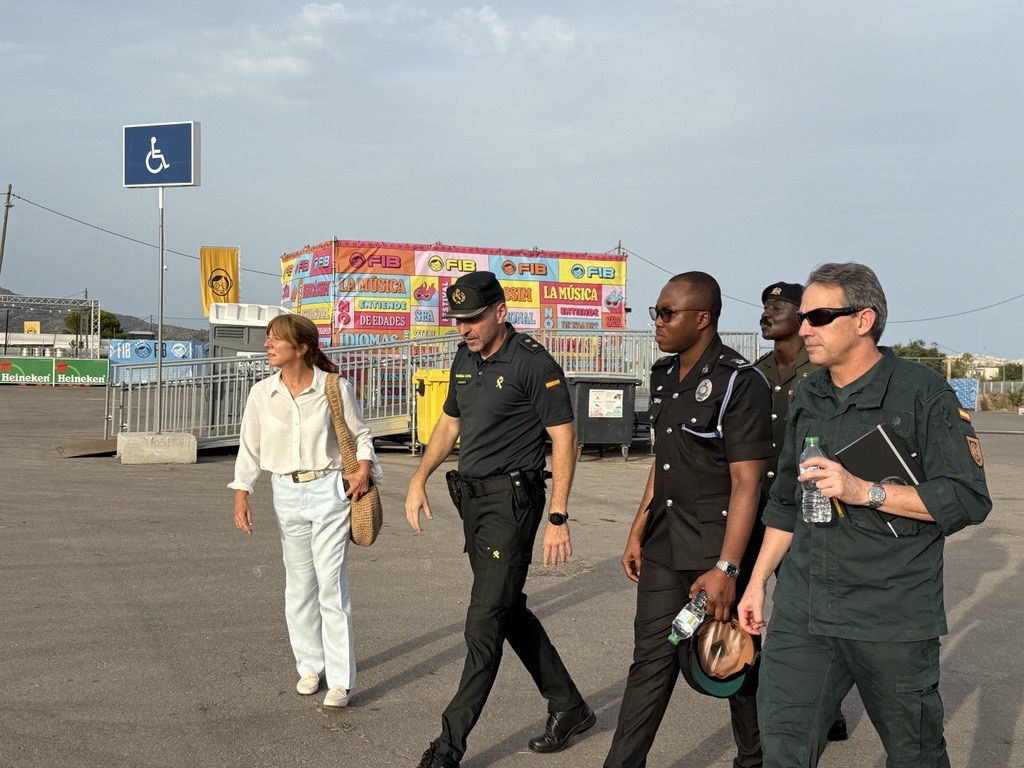
During the FIB, the European ‘Public Spaces+’ project, run by the FIAP and the Civil Guard, has organised an event at which a delegation of senior officers from Ghana’s National Counter-Terrorism Coordination Centre, the police and other security forces were able to see first-hand the security deployment organised for the Festival.
With the support of the Civil Guard Command in Castellón, the Ghanaian delegation has had the opportunity to meet with political and police authorities, as well as the event organisers; to gain an understanding of the coordination and communication between institutions and units; and, above all, to see first-hand and on the ground how the various units and organisations work to ensure the security of an event of this scale.
The Head of Operations at the Castellón Command, who is in charge of the security operation, explained in detail the deployment and the roles of the various units.
For her part, the government’s sub-delegate for the province emphasised the importance of the event, the joint efforts of everyone involved, the security challenges and the importance of sharing experiences with countries such as Ghana.
In addition, the mayor of Benicasim recounted the history of the festival, highlighting that music festivals are an economic and social driving force in the province and in Benicasim, and added that they are only possible with adequate security and everyone’s efforts.
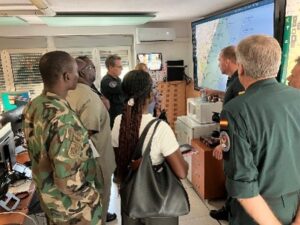 The Ghanaian delegation had the opportunity to visit the coordination centre and attend the daily security meetings. The latter were attended by the Civil Guard, the National Police, the organisers and the local police.
Through the European ‘Public Spaces’ project, operational equipment will be donated to the security forces in the countries with which the project is working (Kenya, Ghana and Senegal), and this occasion was used to make an initial handover to the Ghanaian delegation, although the bulk of the equipment will be delivered on the ground.
Among the activities carried out by the units on the ground, the partners have shown great interest in the use of drones and counter-drones, given the concern surrounding this threat in Ghana. The counter-terrorism deployment of the Civil Guard’s Rapid Action Group (GAR) has played a key role, providing them with the opportunity to understand how the counter-terrorism response is carried out and what resources are used in the event of an attack.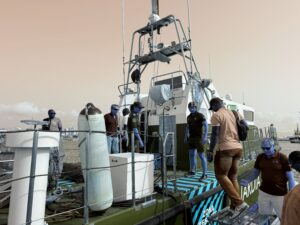
In addition, participants were able to board a vessel from the maritime service and witness the important role it plays in securing our coastline.
The lessons learnt during FIB week will be applied to large-scale operations involving significant public participation in Ghana, such as National Day celebrations, sporting events or music festivals.
The European ‘Public Spaces +’ project aims to improve capabilities for countering terrorist acts in public spaces in three African countries: Ghana, Senegal and Kenya. This visit is a prime example of cooperation in this field between the European Union and Africa.