

29/10/2026
Security forces in Latin America are learning how to understand, identify and analyse the structures linked to maritime drug trafficking.
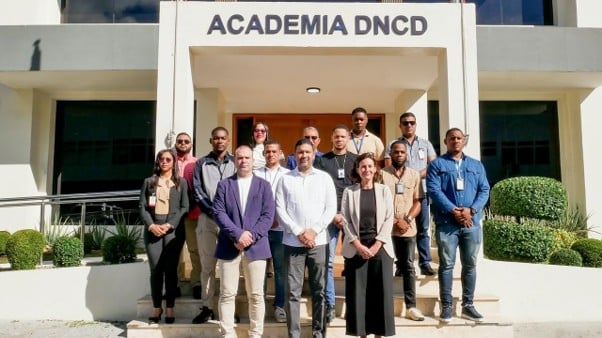
One of the training groups at the entrance to the National Directorate for Drug Control (DNCD).
To respond effectively to organised crime, it is necessary to understand how it operates: its behaviour, its modus operandi, its geostrategic distribution and its division of roles. This involves analysing each key element of a criminal organisation from a technical and legal perspective.
Understanding the threat also requires sharing experiences: from the application of policing tools on the ground to the investigation of criminal organisations and the execution of operations against drug trafficking.
Combining training with operational activities clearly enhances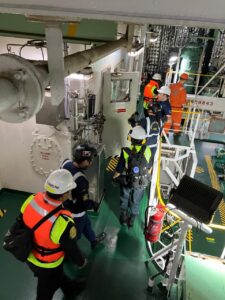 knowledge and, consequently, the coordinated response of countries. In this context, the European Union’s port cooperation project, SEACOP, has developed a dynamic curriculum comprising a core programme and a specialised programme, implemented at different levels.
With the aim of strengthening investigative capabilities in the fight against illicit trafficking by sea and transnational organised crime networks, the curriculum has combined theory with operational practice, and covers everything from the structure of trafficking networks, an understanding of the various operational tactics employed, concealment and retrieval techniques within containers, and the stages of a drug-trafficking operation, right through to the legal frameworks underpinning the use of police tools to initiate and strengthen investigations in accordance with the legal architecture in place at national, regional and international levels.
Over the past year, 10 courses have been delivered in Peru, Argentina, Uruguay, Costa Rica, Ecuador, the Dominican Republic and Paraguay, attended by more than 150 participants representing various agencies such as navies, coastguards, police forces, customs authorities, prosecutors and judges. These courses were delivered by Chief Inspector Alfredo Díaz, the project’s regional coordinator at FIAP.
Given the variety of contexts in the countries where SEACOP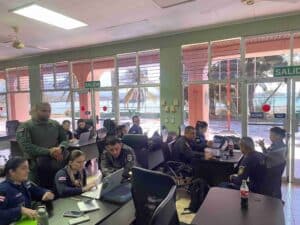 operates, it is important to note that the courses have been adapted to the specific circumstances of each country. It is not enough simply to provide general training; rather, the project has tailored each training programme to make it as useful as possible, taking into account the situation regarding illicit maritime trafficking in each country.
In light of this, the European SEACOP project, which focuses on port cooperation, has established the GRES (SEACOP Special Response Group) initiative. These courses complement the operational aspect of the GRES strategy, under which several regional operations have been carried out, with various countries working together on different types of vessels – such as fishing vessels, roll-on/roll-off vessels, general cargo ships and pleasure craft – or in a specific geographical area such as the Paraná–Paraguay waterway.


