

28/10/2026
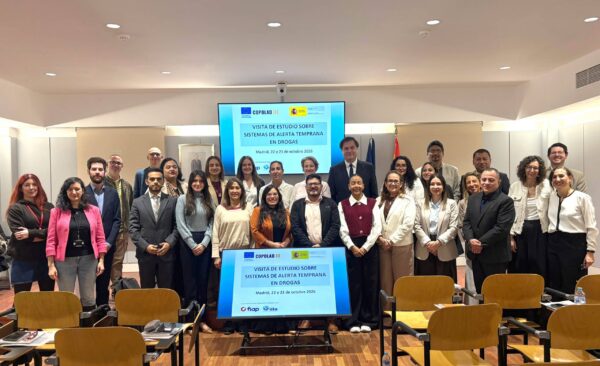
Madrid hosted a study visit organised jointly by Spain and Portugal, during which Latin American representatives learnt about the Spanish and Portuguese experience in the early detection of and response to significant changes in drug trends.
Fourteen representatives from Ecuador, Honduras, Costa Rica, Guatemala, Panama and Paraguay have learnt about the Spanish Early Warning System on Drugs (SEAT) at a meeting that fostered information exchange between the two regions, with a view to establishing and strengthening their own Early Warning Systems (EWS).
The visit was organised under COPOLAD III, the European Union programme for cooperation between Latin America, the Caribbean and the European Union on drug policies. The programme is led by the Foundation for the Internationalisation of Public Administrations (FIAP), and the visit had the support of Spain’s National Plan on Drugs and the Spanish Observatory on Drugs and Addictions.
The meeting took place at the headquarters of the Government Delegation for the National Plan on Drugs (DGPNSD). It was attended by the Government Delegate for the National Plan on Drugs, Xisca Sureda, who stated: “International cooperation is a necessity in a globalised world. Only through such collaboration can we make progress in protecting health.”
The study visit also included an initial stage in Lisbon. There, participants learnt about Portugal’s and the European Union’s experience in drug early warning, with the collaboration of the European Union Drugs Agency (EUDA) and the Institute for Addictive Behaviours and Dependencies (ICAD). They also visited several toxicology and forensic laboratories to gain first-hand insight into the procedures used to analyse new psychoactive substances.
EWS are multidisciplinary, inter-agency networks designed to detect early any significant changes in drug markets and patterns of use, as well as new substances and other emerging risks. The rapid exchange of information between institutions and professionals improves the capacity to anticipate such changes and helps coordinate responses to threats to public health and safety.
 This exchange of experience strengthened the knowledge and the technical and operational capacities of the participating countries. It also helped to identify new opportunities to develop and consolidate their national early warning systems.
The Director of COPOLAD III at FIAP, Borja Díaz Rivillas, said: “Early warning systems are a key tool for anticipating risks and improving responses to the changing dynamics of drugs. Through COPOLAD III, we support Latin American countries in strengthening these systems, promoting the exchange of knowledge and experience with Europe in order to move towards more effective, evidence-based public policies.”
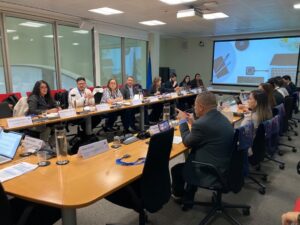 During the sessions, the delegations gained first-hand knowledge of the European Union’s experience in early warning and how its systems operate. They also learnt about the various tools and information sources used to identify emerging drug-related phenomena.
Professionals from the National Plan on Drugs, the Spanish Observatory on Drugs and Addictions, health and hospital services, analytical laboratories, scientific institutions and specialised organisations took part in the meeting. Their involvement gave a comprehensive picture of all the stakeholders in a system of this kind. This approach highlighted the cross-cutting nature of early warning systems and the importance of coordination between different actors to generate useful information and trigger swift, effective responses.
Experiences from a range of fields were also presented, including hospitals, drug-checking services, syringe residue and wastewater analysis, and national substance analysis laboratories.
The sessions also presented the progress made and the challenges identified in the region, and set out the next steps for establishing, strengthening and consolidating national EWS.
The meeting was an opportunity to promote bi-regional cooperation and peer learning, and to exchange knowledge, methodologies and good practice between European and Latin American institutions.