

01/07/2026
Over the years, the country has gradually consolidated its institutions and broadened its understanding of, and approach to, the drug issue.
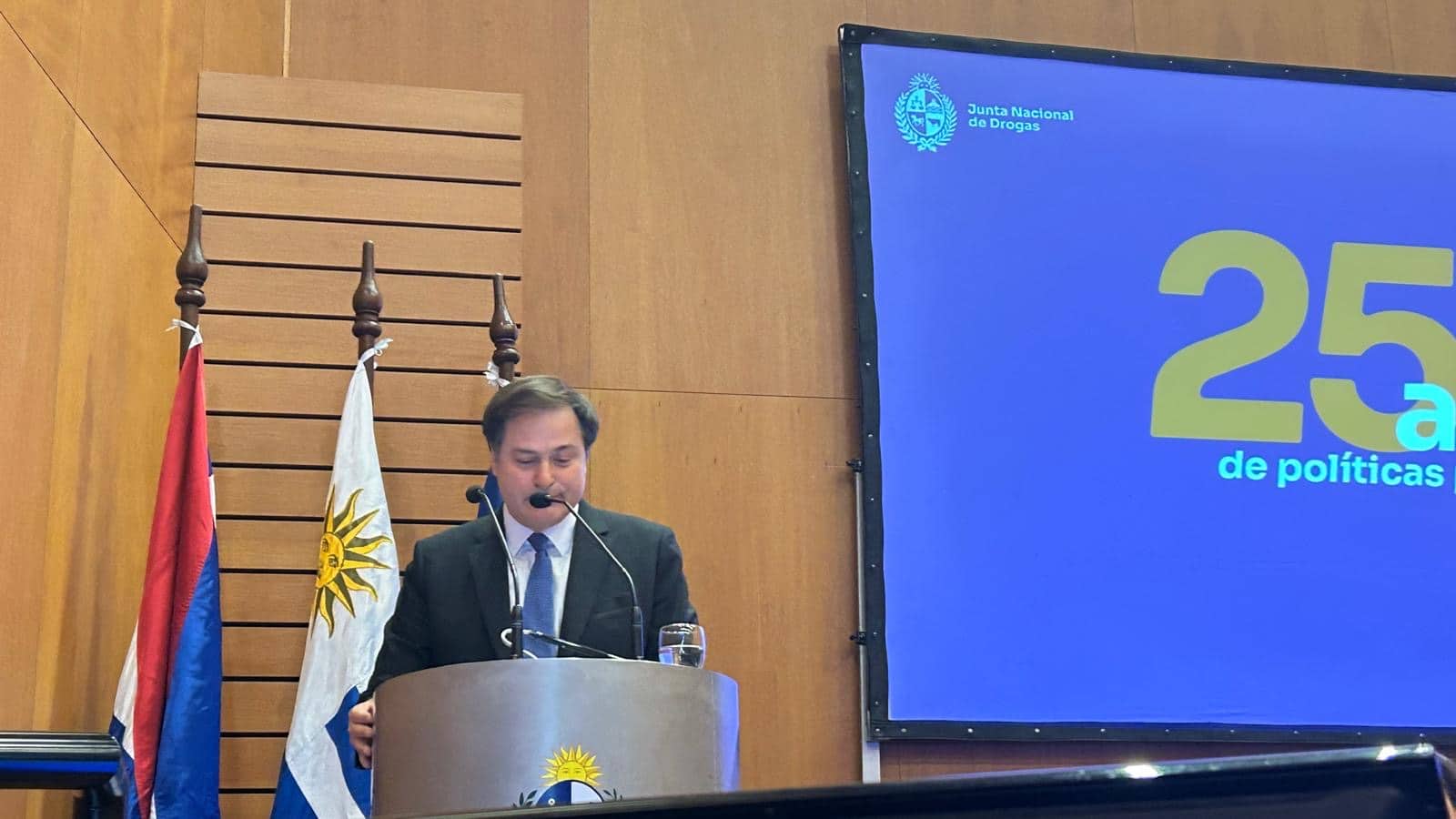
Borja Díaz Rivillas, the COPOLAD III project director at FIAP, at the presentation of the evaluation on 26 June.
Uruguay has marked the 25th anniversary of its public policies on drugs with the launch of the report Evaluation of Public Drug Policies in Uruguay in the 21st Century, supported by the European Union’s COPOLAD III programme, led by FIAP.
The launch, on 26 June, coincided with the International Day Against Drug Abuse and Illicit Trafficking and formed part of a two-day conference dedicated to analysing the evolution of Uruguayan policy and exploring various care and treatment initiatives.
The evaluation, spearheaded by the National Drugs Board, has been an exercise in analysis and institutional learning. Participants included the director of the COPOLAD III project at FIAP, Borja Díaz Rivillas, alongside the Secretary-General of the National Drugs Board, Gabriel Rossi, representatives from Uruguayan institutions and other national authorities.
“Evaluating 25 years of public policy is an exercise in institutional and democratic maturity. It means recognising the progress made, identifying the difficulties and using what we have learnt to make better decisions,” emphasised Díaz Rivillas during his speech.
One of the main conclusions of the evaluation is Uruguay’s ability to maintain significant institutional continuity in a particularly complex field. Over the last 25 years, there have been successive governments, priorities and political contexts. However, the country has progressively consolidated its institutions and broadened its understanding of, and approach to, the drug phenomenon.
The evaluation analyses this evolution in areas such as risk management and harm reduction, care and treatment for people with problematic drug use, and the regulation of markets for psychoactive substances.
Throughout this period, Uruguay has moved from a response focused primarily on supply control towards a more comprehensive policy that incorporates public health, human rights, social protection and evidence-based approaches.
The National Drugs Board, the Uruguayan Drugs Observatory and the care network have also been strengthened, whilst regulatory responses have been developed in areas such as tobacco, alcohol, psychotropic drugs and cannabis.
Among the challenges identified are improving inter-institutional coordination, enhancing the quality and coverage of services, and the need for more detailed information, disaggregated by gender and region.
Recognising these difficulties does not diminish the value of the progress made. On the contrary, it demonstrates the existence of institutions capable of critically analysing their work, learning from experience and adapting their policies to new needs.
Uruguay also contributes by sharing its knowledge and experiences with other countries in Latin America and the Caribbean, thereby promoting learning amongst public institutions and the adaptation of responses to the specific characteristics of each context.
In this new phase, COPOLAD III will continue to support Uruguay in areas such as prevention, risk and harm reduction, support for women and people of diverse genders, treatment within the penal system, the strengthening of information systems, the control of chemical precursors and the management of seized assets.