


21/07/2026
The European Union’s SERPAZ programme is organising a seminar on the prevention of money laundering in the notarial sector.
Notaries are also obliged to ensure compliance with anti-money laundering regulations. This includes customer identification, due diligence and the reporting of suspicious transactions to the Financial and Economic Analysis Unit (UAFE). Notary offices are considered ‘regulated entities’ and must implement strict measures to prevent their services from being used for illicit activities. Furthermore, notaries play a key role in detecting suspicious transactions and preventing fraud, making them vital agents in the fight against money laundering.
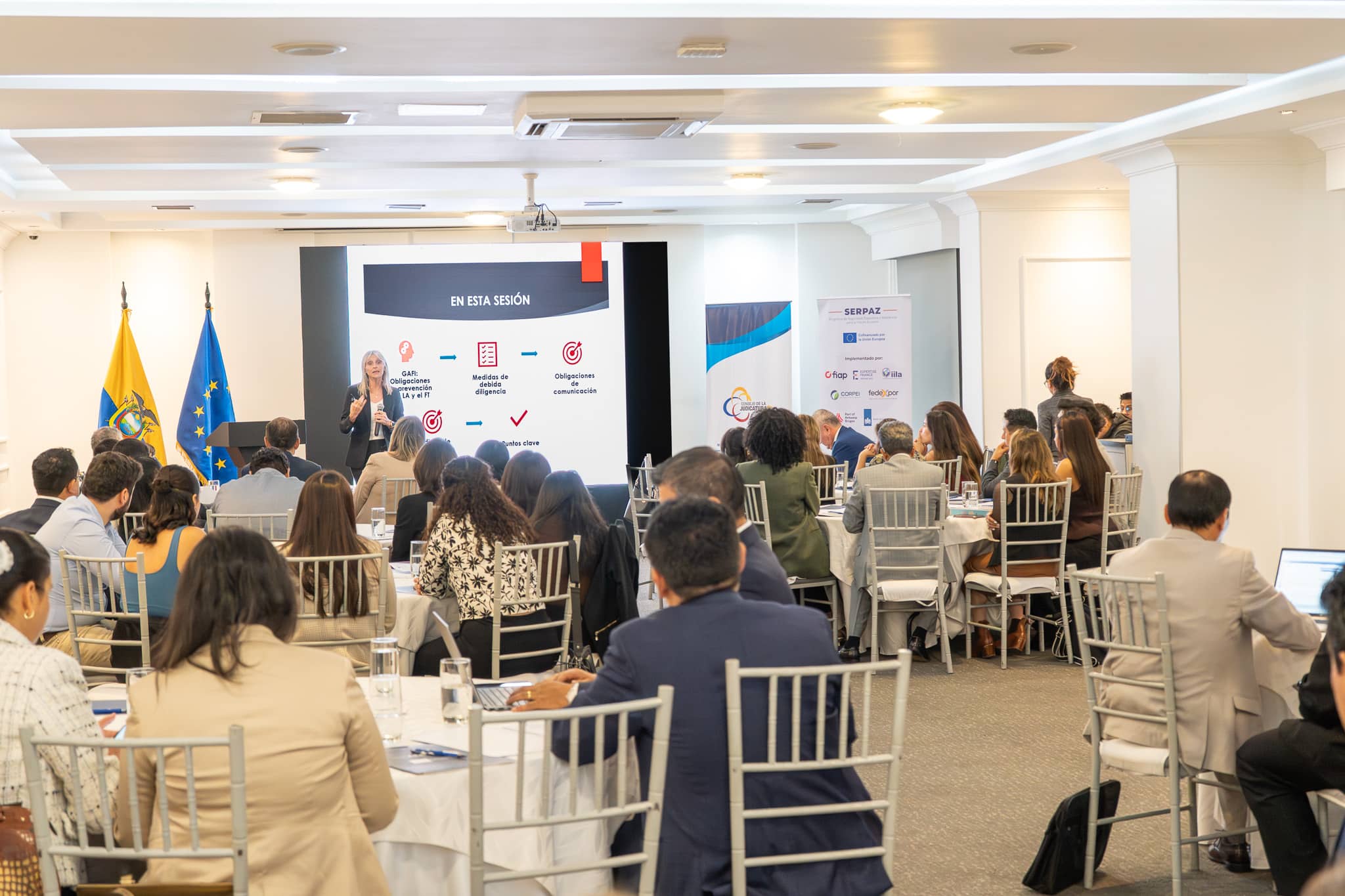
In light of this situation, the European Union (EU) SERPAZ programme, through its anti-money laundering component implemented by FIAP and Expertise France, has organised the seminar: “Money Laundering Prevention Models: The Spanish Notarial System (OCP-CGN) and Regional Approaches”.
The event was attended by 210 people from public bodies such as: the Judicial Council, notaries public, the Financial and Economic Analysis Unit (UAFE), the Attorney General’s Office, the Superintendency of Banks, the National Police, ASOBANCA, the Superintendency of Popular and Solidarity Economy, the Ministry of the Interior and international experts.
During the event, the president of the Ecuadorian Federation of Notaries emphasised the notarial sector’s commitment to transparency, regulatory compliance and the timely identification of risks associated with potential illicit transactions. In this regard, he stated that such forums for exchange enable the sector to learn from international experiences, strengthen its capabilities and promote prevention models that contribute to building a fairer, more trustworthy and safer society, whilst safeguarding legal certainty and the rule of law.
The aim of the seminar was to strengthen the technical, operational and supervisory capabilities – with a risk-based approach – of institutions and professionals involved in the prevention of money laundering within the notarial sector. It enabled participants to familiarise themselves with international standards on anti-money laundering and countering the financing of terrorism, the recommendations of the Financial Action Task Force, due diligence, the identification of beneficial owners, typologies applicable to the notarial sector, risk-based supervision and red flags in notarial transactions.
The programme combined presentations with case studies and practical exercises on identifying beneficial owners, as well as the analysis of typologies and the review of risk indicators applicable to notarial transactions and acts.
The event provided an opportunity to compare Spanish and regional experience with the institutional and operational reality in Ecuador and also helped to identify opportunities for improvement and possible avenues for future cooperation, such as an agreement with the Centralised Prevention Body of the General Council of Notaries of Spain, along the lines of those implemented in Peru and Costa Rica.
The European Union and the SERPAZ Programme will continue to support Ecuador in adopting international best practices and in creating opportunities for cooperation and training that will enable progress towards a more coordinated, preventive and effective response to money laundering.